Showing posts with label shoulders. Show all posts

Tuesday, June 24, 2014

Yoga Tip Tuesdays: the 'other' shoulderstand

When you think of shoulderstand, you probably think of the popular images of someone upside down with their legs ramrod-straight in the air, their body folded nearly in half at the neck, their chin pressed to their chest. Yet let's face it - the modern, "gymnastic" version of shoulderstand that we are used to seeing is simply not practical - or safe - for everyone. It requires a high degree of backwards flexibility of the shoulders, for starters. It also requires nearly 90 degrees of forward flexion at the cervical spine and places a lot of the body's weight on the delicate vertebrae at the back of the neck. Not to mention that if you are a woman with anything over a C-cup, you may feel like you're at risk of smothering yourself!

Thankfully, there is an alternative variation of shoulderstand that gives you exactly the same benefits as the "gymnastic" shoulderstand. In sanskrit this pose is often referred to as "viparita karani asana." It's basically a slightly modified version of shoulderstand, where instead of trying to get your body straight up and down, you allow your body to settle in a 'pike' pose, with a comfortable angle between the torso and legs. This allows you to take more of the weight of the body in the hands, elbows and arms, which decreases the weight and pressure on the cervical spine. It also creates more 'breathing' space between the chin and the torso - ideal for bodybuilders with tight pecs and shoulders and for busty women. The pose has a beautiful, mudra-like feel to it and allows you to breathe deeply into the belly. Drishti is either straight up, or at the belly if you can do this while still keeping the chin lifted high.

I can not say enough how much I love and prefer this pose!! Personally, I now only practice this asana instead of shoulderstand and I always teach it in classes (I call the two versions "classical" shoulderstand and "gymnastic" shoulderstand) - yet it took me years to come across it simply because it isn't taught in our modern asana classes. So without further ado, here you have it: viparita karani asana.


(NB: The usual counter-indications for this pose apply: you shouldn't be practicing inversions if you have untreated high blood pressure, angina, glaucoma, or osteoporosis of the spine, wrists or shoulders.)

Readers, what poses would you like to see modifications for on the blog??

Thursday, June 12, 2014

7 stretches for neck and shoulders you can do at your desk

Dearest readers,

Well, I've been absent from the blog for much longer than I intended! Life has been busy these past few months, both personally and professionally. But in any case, I'm back and have some reader-requested posts lined up for you!

Thanks to all of you who have continued to visit and comment on the blog while I've been away - I especially appreciate those of you who have reached out by email or on Facebook to ask your questions! Keep them coming.

So without further-ado, a long-awaited reader request: 7 simple stretches for tight shoulders that you can do right at your desk! It's a simple sequence that takes about five minutes - enjoy!


Sunday, March 17, 2013

Thoughts on first led primary practice after a year


Last weekend I was down in Vancouver staying with a friend, and on Sunday morning we went to a led Primary practice at a lovely independent little shala. The practice leader had just returned from 3 months in Mysore where he was assisting Sharath, so I'm assuming we were doing Sharath's count, for those Ashtangeeks out there who are interested in those sorts of details. :)

It was my first full Primary (led or home) since I "broke up" with my Ashtanga practice nearly a year ago, so I have been reflecting on how it felt. Here's a rundown:


  • Sweaty: In a good way! The studio was heated and fairly full, and once I got into the twists (which always generate heat for me), the sweat really started to flow. Compared to my chilly morning practices at home, it felt great!
  • Long: I'm not sure how long actually, a bit under 2 hours I think, but given that I spend most of my waking hours bouncing down a mountain these days, I don't usually practice for more than an hour or 90 minutes. At one distinct point towards the end, my concentration flew out the window and the leader called me out for being a breath a head on the vinyasas. Whoops!
  • Smooth: I thought I would find the practice hard, given how long it had been, but it felt smooth and I had enough energy to carry the practice all the way through. I have to say I would have been hard-pressed to do it all the next day, though.
  • Unconstrained: I didn't do the rolls in Garbha Pindasana (I never liked those), and I didn't even attempt cakrasana (never could do that without pinching my neck... "one day, gurunam" as my first teacher used to say), and I didn't feel "un-Ashtangic" about it, because I have made my peace with being un-Ashtangic, if that makes sense!
  • Same-old, same-old: By which I mean the same old irritations flared up, that led me to stop doing exclusively Ashtanga in the first place: wrist pain, and rotator cuff (shoulder) pain, both on my right side (I'm positive my cakrasana issues are connected to these too, and it's all rooted in my precious curvy spine). My vinyasas are a lot smoother and more controlled as a result of the work I've been doing over the last year, but doing every vinyasa, even carefully, was hard on those weak spots. I'm pretty terrified of injuring my wrist again so I've renewed my efforts to work on those problems with targeted movements in my home practice. 
  • Different: My first Ashtanga teachers learned the practice in the early 90's, so there were some small differences in the practice that took me by surprise. The practice leader, Geoff, emphasised the inner aspect of the practice as opposed to what the body can do, which was great. He also told us that Sharath is teaching a different version of the tristana these days, which is breath, drishti and alignment of the body, with the bandhas being rolled into "breath". My injury-wary inner teacher approves of the latest addition, although I think the young man next to me, sweating, grunting and twisting himself into postures, could perhaps have used some more explanation. ;)
At the end of the practice, the practice leader asked me how it felt, having been away from the practice for so long. I told him it felt great, but mentioned it was hard on my wrists.

Thinking about it afterwards, it felt like going back to a house you used to live in after some time away. It feels familiar, maybe even nostalgic, but it's no longer home and you have a new reality.

NB: The cover image was sourced from Ryan Spielman.

Wednesday, February 27, 2013

Yoga Tip Tuesdays: The Lower Ribs "Escape Valve" - A Simple Tip for Back Stability

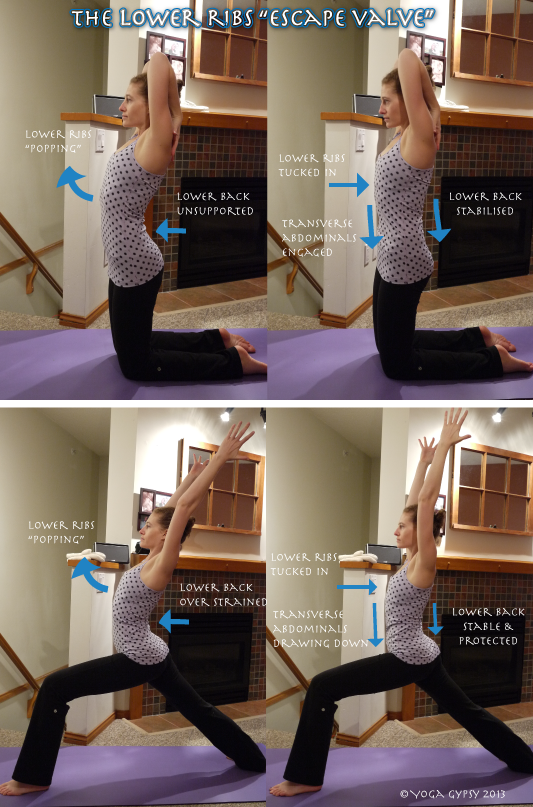
Today's Yoga Tip is a short but sweet one that will help you to be more precise in your alignment, activate the transverse abdominals, go deeper into the backs of your shoulders, protect your lower back, and improve your overall core stability.

Many of us, when we do yoga, "think" with the front of our bodies. So when we are asked to open the back of our bodies, we unconsciously try to manifest the instruction on the front body.  In some cases this is simply because our minds aren't used to thinking about the back of the body (out of sight, out of mind!). Or we may have tightness in the back body, and so we try to compensate with the front body.

The example I want to look at today is a common one: when working to stretch the backs of our shoulders, or when moving into a backbend, we lengthen our spine, lift our collarbones, and let our lower ribs "flare" or "pop" out. It feels like we are stretching more deeply when we do this, but in fact we are using our ribs as an "escape valve" to compensate for tightness in our back body.

So, what's the big deal? Well, when this "escape valve" becomes a habit, you will carry it with you throughout your practice, including into more challenging poses like backbends.   When the lower ribs are "popped", your lower back isn't being stabilised by its synergists, the transverse abdominals. This can cause excess load to be carried by the lumbar spine (the lower back), which can possibly lead to strain or injury.  You want to be especially careful of this if you (like me) tend towards a "curvy" lower back in general, because it can also mean that your back is taking undue strain even in postures that are not backbends (and probably in your day-to-day life, as well).

In either case, this is really simple to correct once you're aware of it: use your abdominals to pull the lower ribs back in and down and keep them close to your body. Then go back into the pose, staying aware not to let your ribs flare out again.

Clear as mud? Have a look at the pictures!


~~~~~~~~~~~~~~~~~~~~~~~~~~~~

If you've read this far, I'd love your feedback! Was this tip helpful? Is there anything else you'd like tips about? Leave a comment!

Tuesday, October 30, 2012

In search of a balanced practice, and why the Ashtanga Primary series isn't one (for me)


There's a discussion going on over at the Confluence Countdown about "holding students back" in the Ashtanga system. The blogger, Bobbie, makes some very interesting points about the system from a philosophical / psychological perspective, the discussion of which I'll leave to her blog. I'm outta that relationship, remember? ;)

What is interesting to me is the question of whether it's good for students to practice exclusively the primary series for too long. Bobbie and many of the commenters come to the same conclusion that I did, that practicing exclusively the primary series for years on end does not give your body a healthy or balanced practice. And since the system seems to have developed rules over the years about when/how students are "given" (I agree with Bobbie, I also dislike that word!) the next pose or series, e.g. being able to bind in Marichyasana D or being able to stand up from and drop back to Urdvha Dhanurasana, many students find themselves practicing primary for years.  Many, like myself, don't have regular access to a teacher who can "give" them the next pose or teach them 2nd series. Nonetheless, we are told not to do other yoga, to "pick a system and stick with it," that doing other yoga will somehow dilute the transformational power of the practice.

Bobbie and many commenters on the post feel what I felt, deep inside my body, and what led me to "break up" with Ashtanga and start practising other poses - that the primary series is not, IN ITSELF, a balanced practice. And quite possibley it wasn't intended to be that way, but that is another conversation. In any case it's good to hear that many of the senior teachers seem to agree.

Essentially the points made in the post and the comments, which may not be experienced by everyone, but which me and my body agree with wholeheartedly after practicing Primary for 3 years:

[NB: In response to a comment left on the blog, I realised that my original post used language that was a bit too absolute, so I've edited the original wording a bit to emphasise that what I'm talking about is relativity within the sequence. I've also added some more anatomical precision.]
  • Primary has a relatively greater emphasis on forward bending, stretching the muscles of the  back (in particular the erectors spinae and the quadratus lumborum) more often than it strengthens them (one of the best poses for that is shalabasana). In some people, an overemphasis on forward bending can be destabilising for the SI joint. Sciatica or SI pain, anyone?
  • It develops relatively more upper front-body strength (pec minors) without developing the corresponding upper back-body strength (rhomboids and rotator cuffs). My yoga therapy teacher believes that this is why many Ashtangis (and others who practice vinyasa-based yoga) develop shoulder injuries, because those crucial muscles that stabilise the shoulder blades can become relatively weaker on the back than the front. Another effect of this is that the front body, especially the front of the shoulders, while getting very strong, may become tight and "closed", as there are relatively fewer poses to open it up (the best stretches for here are back-bends with the arms extended behind the body, e.g. purvottanasana, ustrasana, shalabasana, dhanurasana).
  • While Primary certainly stretches the hamstrings, it doesn't provide space for deep hip-opening in certain directions. There is a lot of external rotation and flexion of the hip joint, but relatively little extension or internal rotation. The sequence also strengthens the psoas, the quads and the external rotators of the hip (the glutes, the piriformis) relatively more than it stretches them. These muscles are key muscles for postural stability and the health of your spine, and balanced hip-opening (internal and external) is important for maintaining the safety of the knees and the lower back.
Since I stopped practicing Primary about 6 months ago and moved to a more balanced practice, I am feeling my body in a whole new way. Most noticeable is that my back body is much stronger as a result of the targeted postures I have been doing, and this has significantly reduced the shoulder pain I used to often experience (which was also related to my scoliosis). This has also made my posture better and I've made some progress towards reversing the forward-hunch that my shoulders had developed through a combination of too much computer time and too much emphasis on forward-body strengthening (in particular the pec minors). No thanks, kyphosis, not for me!

The moral of the story, for me at least?
  • Listen to your body and think about finding balance in your long-term yoga practice. 
  • If you stretch a muscle, strengthen it. It doesn't have to be the same day, but overall!
  • If you stretch/strengthen somewhere, be sure to also stretch/strengthen its opposite (antagonist).
  • If you feel like your body is imbalanced from a practice you are doing (chronic pain or recurring injuries are a good sign), listen to those feelings and find a teacher or yoga therapist who will help you identify what's going on.
And above all, remember, it's only asana!


Saturday, June 23, 2012

Not the easy road... More on "breaking up" with Ashtanga

Last week, I posted a letter to Ashtanga about "seeing other yoga". I didn't really mean it to be a controversial post, but it did spark some discussion.  For some more good reading, Damn Good Yoga posted a perspective on her blog which also generated a lot of comments and discussion.

In any case, upon browsing the Ashtanga blogosphere, there seems to be a perception that people leave Ashtanga because it's too hard, or because they can't handle the discipline and commitment, or they are shying away from ego-destroying transformation. And maybe some people do - but I'm not really in a place to judge anyone else's reasons or motivations.

I find this interesting because for me, the decision to branch out from the Ashtanga path was a decision to leave my comfort zone, both physically and on more subtle levels. You see, as I mentioned in my letter, I was taught that Ashtanga was all the yoga I needed. That it was a complete system that would heal and balance my body and my mind, well, completely. So when I recently realised that this wasn't happening for my body, it made sense to me that I needed to modify my practice. It honestly wasn't a big drama for me - after all, my "loyalty" is to myself and my journey, not to one asana system or another. [Not to mention that as a teacher, I feel like I need to learn as many different approaches as possible, to be able to teach to as many different needs as possible!]

The realisation that Ashtanga wasn't working for me in a "complete" way came during my Level 2 yoga teacher training, and in particular I had 3 major "breakthroughs":
  • I realised that my shoulders have become imbalanced - partly this is the way my body is put together, and partly it's postural and work-related (damn computers). Basically, the front of my shoulders are quite strong and the muscles on the backs of my shoulders are comparatively quite weak, and this was causing my shoulders to round forward and causing me a certain amount of back pain. When I say "realised", I mean the kind of realisation that is accompanied by immense physical and emotional release - not the kind of passing thought you can just ignore. Yogis will know the kind I mean. Unfortunately, Ashtanga with its emphasis on forward-and-down vinyasas had made that imbalance worse. According to my Yoga Therapy teacher, this is pretty common among Ashtangis - many of whom suffer from shoulder injuries or pain at the back of the shoulder because those muscles remain comparatively underdeveloped. The good news is, it's fairly easy to work on and with the help of some yoga therapy moves, in a few short months since my TT I have already made huge progress in that area.
  • As I've already mentioned, I realised that my psoas and hip flexors were just not getting the love they needed. The psoas is of particular concern to me since it affects lower back pain and imbalance, which I already have my dose of thanks to my scoliosis. This became crystal clear to me when we were working on Eka Pada Raja Kapotasana / King Pigeon pose. I couldn't BELIEVE that after 3 years of Ashtanga I had made absolutely no progress with this pose. Wow. That just didn't seem right to me - but once my teacher observed where my limitations were in the pose - those pesky psoas and hip flexors among them - it made sense - and became clear that my Ashtanga practice was just not addressing those muscles in the way that my body needed.
  • Finally, as I mentioned, I have scoliosis. Luckily for me, it's quite mild, but it is progressive - i.e. the muscular imbalance, unless counteracted, gets worse with age. When I first started Ashtanga, I accepted the idea that the primary series was "yoga therapy", and therefore, my practice would be enough to relieve my imbalance. And while it did make the weaker side of my back stronger, over time it also caused the QL muscle on the strong side of my back (that's the thick muscle that runs either side of your lower spine) to become a rock-hard, ropey knot, which is exactly the kind of imbalance I need to avoid if I want to manage my scoliosis as I get older. Cue more massive release, and the realisation of just how badly I NEEDED to do some kind of practice that would allow me to dig deeper and really work on that area.
Now, I honestly think it would have been easier to just stay in my comfort zone and keep practicing Ashtanga, maybe throwing in a quick yoga therapy sequence in the afternoons to work on some of those target areas. Easier to remain attached to progressing along the Ashtanga path, and keep working towards second series. Easier on my ego, because I wouldn't have to face Eka Pada Raja Kapotasana or go deep, deep into that damn psoas and feel like I'm losing my mind.  But that would not have been in line with Satya, truthfulness, Aparigraha, non-grasping, or Ahimsa, non-harming. And so I'm taking the other path, moving out of my comfort zone, and into practices that challenge the imbalances in my body - and take me to the edge both mentally and physically.

Is it easier? Heck no. Am I less committed to my yoga? If anything, I'm more comitted. Is my practice suddenly less disciplined, more comfortable, or less confrontational? Actually, the opposite!  Of course I do write this with the caveat that I've been practicing yoga (self-practice) for nearly 10 years, have worked on these issues with an experienced Yoga Therapist, and have 500 hours of formal yoga teacher training that have given me the skills, maturity, and self-knowledge to design asana sequences that both nourish and challenge my body, that are well-balanced but also target my imbalances. And when it feels right, I'll keep practicing Ashtanga, too.

Funny, so much fuss about which type of asana we are practicing, when really, it's only 1/8th of the practice! I have found that as time goes on, I become less and less attached to WHAT I am practicing and more focused on HOW. Which is what yoga is all about, I guess. :)

Readers, what have been your "yoga realisations" or your experience with attachment?

Sunday, March 27, 2011

5 Simple Stretches to ease Shoulder Pain

A while ago I did a post with some simple stretches to ease back pain.  Recently I got a comment on that post asking for something similar for shoulders - et voila!

I think most of us who work at desks have a tendency to hunch up and hunker down over our keyboards, and obviously all the stretching in the world can't replace good posture and a healthy work space!  If you are working long hours in the office, make sure to take regular breaks and walk around, swing your arms, roll your shoulders, and stretch a bit!

Here are a few really simple stretches that can help.  They work really well as a little flow, but can be done individually as well - and best of all, they can be done in your chair while at work.

*If clasping your hands together isn't comfortable in some of these poses, try using a small length of fabric -  a strap, belt or even a teatowel - and you will get a great stretch!

1. Start by sitting up straight with both feet evenly planted on the floor (or both sitting bones if you are sitting on the floor).  Bring your hands beside you, or even better, underneath you and take 5 deep breaths while you focus on dropping the shoulders down as far away as you can from your ears.  Then:


2.  Inhale, and reach your arms up overhead.  Clasp the fingers together and turn the palms upwards*.  Now bring your focus back to the shoulders and again, try to drop them away from your ears while still lengthening upwards through the crown of your head.  Hold for 5 breaths or about 30 seconds.


3.  Release your hands and bring them down behind you.  Once again interlace the fingers behind your back*, and gently lift your hands away from your lower back until you feel a nice stretch.  Hold for 5 breaths or about 30 seconds.


4. Release your arms and stretch them out in front of you, palms up.  Then, cross one arm over the other, above the elbow.  Bend the bottom arm (bringing your hand towards the ceiling) and gently pull the outstretched arm to that side.  Hold for 5 breaths and repeat on the other side.  If you have more flexibility in your shoulders, you can also try Eagle arms, also pictured.


5. Bring one hand to your shoulder, palm up.  Stretch the other arm all the way up to the ceiling and then bend it at the elbow, clasping your hands together*.  Now from the hand on the shoulder, gently pull until you feel a good stretch, then hold.  Try holding about 30 seconds on each side.

Hope these help!  Readers, what little stretches feel great for your shoulders?

If you liked these stretches you may also enjoy: 7 stretches for neck and shoulders you can do at your desk