Showing posts with label teaching. Show all posts

Saturday, July 20, 2013

Yoga with hypermobility


The benefits of yoga have become so popularised these days that even my 5-year old niece can rattle a few of them off. But with that popularisation has also come a process of questioning whether yoga is really good for everyone, a discussion in part started by stories of yoga injuries. Generally we associate these yoga injuries with people who are stiff or inflexible trying to push or pull themselves into a pose; but what about the opposite? What about the people who are so flexible that they can fold in half without even trying?

What is hypermobility?

People whose joints have a more-than-normal range of motion are called hyperflexible or hypermobile - the clinical term is joint hypermobility syndrome (HMS), which may also be an expression of the more serious Ehlers Danlos Sydnrome. Research suggests that up to 3 in 10 adults may be hypermobile to some degree, with women being more likely to be affected than men due to the relaxing effects of female hormones. Many people with hypermobility have a 'harmless' variety: that is, they experience no unusual effects except being more bendy than the rest of us. But for others, HMS can be debilitating, causing chronic pain. In either case, people who are hypermobile are generally more prone to injuries, fractures and dislocated joints, because their joints have more mobility than stability.

Yoga and hypermobilility

Hypermobile people may come to yoga because of an injury, one of those inexplicable "I was just walking/running/surfing/playing tennis and then I felt this pain..." injuries that are common among the super-flexible. Or they naturally gravitate to yoga because of their flexibility. Once in a yoga class, super bendy people are often told they are "amazing" by teachers who don't recognise or understand their hypermobility. Some may even quickly want to become teachers themselves, since after only a few months of practice they find themselves doing "advanced" poses with ease. And in a yoga culture that increasingly idolises the physical performance of postures that require extreme flexibility (just do a pinterest search for yoga if you don't believe me!), it may be hard for people to believe that extreme bendiness is not actually what yoga is all about.

However, underneath that ease in bending a hyper-flexible body is the danger that hypermobile joints are lacking the muscular resistance to properly support the joints in the range of motion that yoga puts us through. This may manifest slowly, through unexplained aches and pains after a seemingly "easy" practice; or it may manifest all of a sudden through an injury: a dislocated joint, a chronic pain, or a repeatedly inflamed muscle or tendon.

And yoga is not a miracle-cure: over time, the sustained practice of yoga without counter-balancing hyperflexibility can lead to a dangerous instability in the joints, that can manifest in chronic joint pain and even symptoms of early arthritis.

How can I tell if I'm hypermobile?

You may be hypermobile to some extent if any of the following sound familiar to you:
  • You have always been able to place your hands flat on the floor in a forward bend or flop into the splits
  • Your friends and family all remember your "crazy" flexibility as a child
  • You feel a constant need to stretch but it never seems to satisfy you
  • You are deep in a pose that is supposedly challenging, but you don't "feel" anything
  • After hardly any time at all, you put your body into the positions of 'advanced' yoga poses such as the splits, one-legged king pigeon pose, or touching your head to the ground in wide-legged standing forward bend
  • You sometimes feel fatigued after simply stretching or doing gentle yoga
  • You find it hard to sit comfortably in a chair for a long time and are constantly folding yourself into different positions
In addition, you may be hypermobile in some joints while having a normal or less than normal range of motion in others.

So, should hypermobile people do yoga?

It's easy to understand why many doctors and physiotherapists who work with hypermobile people advise against doing yoga. However, many hypermobile people find that the right yoga practice can help them a great deal by building body awareness and helping them to develop the strength that they will need to balance their natural flexibility. The key thing to remember is that yoga is about balance: in this case, achieving a balance between flexibility and strength.

Guidelines for choosing a yoga class if you are hyper flexible:
  • Find an experienced and well-qualified teacher, preferably someone with some yoga therapy experience or someone familiar with hypermobility, and make them aware of what you are working with. Get them to help you create some goals for your practice that don't rely on flexibility alone.
  • Avoid styles of yoga that emphasise short, fast movements, such as ashtanga or vinyasa flow, until you have built up a solid foundation of strength that will keep you stable and safe from injury in these movement-oriented styles.
  • Instead, choose styles of yoga that emphasise proper alignment, stability and strength, such as Iyengar yoga or Viniyoga.
  • Complement your yoga with simple strength and resistance training, and with core strength building exercises like pilates (again, with an experienced teacher who understands hyper mobility) that will help you isolate important muscles and begin to build strength in key areas.
Some advice for practicing yoga if you are hypermobile:
  • If you can, see a qualified yoga therapist for a one-on-one session to get a personalised assessment and advice.
  • Avoid starting a practice on your own or with a DVD: until you have more experience, you should work with a teacher who can tell you if you are hyper-extending.
  • Don't move too quickly in and out of poses. Take your time to get into poses, making sure you are engaging your muscles during the transitions. For example in any forward bend, strongly engage your quadriceps and feel as if you are trying to "suck" the floor up through your leg muscles.
  • Once you are in a pose, avoid the temptation to go as deep as you can. Try practicing to the "80%" rule - only going 80% of the way into a pose, and stopping there to work on stability. Focus on engaging the muscles around your key joints: ankles, knees, hips, shoulders to make sure they are all strongly supported.
  • Make sure you always put a micro-bend in your knees and elbows to avoid putting too much stress on your joints - combine this with muscular engagement, and you will be properly supporting your joints!
  • Keep your head supported by your neck muscles, and avoid the temptation to let your head flop all the way back in upward-looking poses or backbends.
  • Consider 'gapping' your joints - for example placing a small rolled up towel in between your belly and your thighs in a standing forward fold, placing your hands behind the backs of your knees in a seated forward fold, keeping your feet on "railroad tracks" for Warrior I and other front-facing poses.
  • Avoid hyper-extending backwards in backbends by strongly engaging your abdominal muscles and focusing on the sensation of lengthening your spine instead of letting yourself "flop" backwards.
 Advice for teaching hypermobile students:

Check out this great article for lots of advice, written from the perspective of a hypermobile person who is herself a yoga teacher.


Readers, are you hypermobile or do you think you might be? What have you learned along the way in your yoga practice?

Friday, June 21, 2013

Guest post: 7 Elements of a Great Teacher Training Program

Dear readers, have you ever considered doing a yoga teacher training? Today's post is a guest post by Elizabeth Emberly, who owns Naada Yoga, a Montreal-based studio that is taking a whole new approach to yoga teacher training. Whatever kind of YTT you are considering, the post below offers some true pearls of wisdom! Read and enjoy, and as always, leave your feedback! What did you / would you look for in a YTT?

-------------------------------------------------

As more people begin to reap the physical, mental and spiritual benefits of yoga practice, the importance of effective teacher training programs increases exponentially.

I applaud anyone who, for any reason, wants to embark on a Yoga Teacher Training (YTT) Program. However, because the stakes are high and YTTs cost money, prospective students have to be sure they research to find the program that fits best with them.

Here, to help prospective students, are 7 elements of a great YTT:

1) A program that cares about you
Students enter Yoga Teacher Training programs for many reasons. Whatever your goal(s), the program should endeavor to help you get there. Whether that means empowering you to focus on the benefits of yoga for specific populations, expand your spiritual horizons, or begin a career as a teacher, the best schools have mechanisms in place to help students after graduation.

2) Flexibility
A good program accounts for life outside the studio. It should include flexible hours, and classes should be available both part-time and on the weekends. Similar to a professional program in a university, you should be able to complete your YTT at your own pace.

3) The ability to further your learning
A 200-hour program is normally the first stepping-stone to becoming a Yoga instructor. As your training progresses, there needs to be opportunities for advancement, ideally under the same roof. Ask if a school allows you to further your study via 300-hour or 500-hour programs. Once you acquire the base learnings you may want to take things to another level.

4) Financial value and support
Every student should be comfortable with his/her tuition fees. Flexible payments should be available. At my studio, Naada Yoga, we offer a work exchange program, which reduces tuition costs for the 500hr teacher-training program students by approximately $1000. Whenever possible, try to look for studios that offer similar initiatives and/or grants to help students along the way.

5) Internationally recognized certification
What good is a certification if it’s not from an accredited training school? Make sure the program you enroll in is up to par with any new regulations or alliances that will help you put your best foot forward as a graduate.

6) A real sense of community
Getting through any type of schooling is easier when you are entrenched in a community of learning with like minded peers. It empowers study and fosters personal growth. When choosing a Yoga Teacher Training Program, look for ways the institution welcomes and integrates students, as well as what it does to foster a sense of community. We’ve tried hard to do this at Naada – even taking pains to consider this factor when we designed the studio layout – and it pays off for students.

7) Well-rounded and qualified teachers
You must make sure the teachers involved in your program are of the highest quality. There is no substitute to learning from the best. Variety also matters, because yoga is a rich and diverse discipline. The best teacher training programs have high quality faculties with divergent expertise and multiple perspectives. This allows students to experience and learn different approaches. 

Elizabeth Emberly is the proud owner of Montreal’s Naada Yoga. Naada Yoga offers an extensive Yoga Teacher Training Program that mirrors the approach of a university. The school brings together leading thinkers such as Rodney Yee, Michael Stone, Richard Rosen and others, and features 200, 300, 500 and 1000 hour certifications. For more info visit www.naada.ca/teacher-training


Sunday, March 10, 2013

10 ways to incorporate yoga philosophy into your teaching or practice


Last week or thereabouts, I wrote about my dissatisfaction with the way that I teach yoga as a mainly asana-centred discipline, and haven't really found a good balance of also imparting the philosophy of yoga. (NOT as a religious discipline, as discussed in this post about why yoga is not a religion.)

The post generated a lot of comments, and made me think, a lot, about how to practically incorporate more philosophy into your average asana class. This is a mish-mash of my own ideas, and commenters' suggestions - I can no longer really remember who said what, but if you'd like to take credit for your ideas, feel free to leave a comment!

10 practical ways to incorporate yoga philosophy into your teaching (or your practice)

  1. Speak from the heart, and don't be afraid!  Talk only about things that resonate deeply with you. Don't just throw in a bunch of waffle because you feel you have to - if it doesn't resonate with you, it won't resonate with your students, either.  If you are among those who believe that yoga is more than just asana, know that you are not alone! Take the plunge, and know that you are doing exactly what you are meant to be doing. :)
  2. Tell stories that people can relate to. Tell a story from your own experience, something you learned, or relate a philosophy concept to something everyday. Yoga philosophy is about life off the mat, and this is a nice way to get people thinking about how to apply it to their lives. The best stories often come from our own questions or mistakes, and it lets your class know that you are just a person struggling with it all, too.
  3. Use the yoga sutras as a class theme or as the basis for a pre- or post-class discussion. Take a few minutes before or after the asana practice to have students sitting quietly with their breath, and during those moments, talk briefly through a point in the yoga sutras and allow students to meditate on that concept. If it's your style, weave the theme from beginning, throughout the asana practice, all the way to closing.  There are so many interesting sutras to choose from, you could probably do this for years without ever getting stuck for new material! Possibly best to avoid the ones about levitating, though. ;)
  4. Go back to the basics. Ideas like concentration, gaze, focusing on your breath, listening to your body - these may seem like a given if you've been doing yoga for a while, but for new students the simple things are still new. Don't underestimate the power of going over the simple concepts again and again, even if it's just a mention of how asana is only one part of an eight-limbed practice.
  5. Use concepts from yoga philosophy as the basis for guided meditations. For example, the koshas (sheaths), yamas (restraints), niyamas (actions), prakriti/purusha (ego/true self), moksha (freedom), or other concepts. The koshas work particularly well here, but really, you could script a guided meditation around almost anything.
  6. Market your yoga classes as "asana with a bit of philosophy". Errr, ok, it might need to sound a bit cooler than that. "Roots of yoga?" "Deepen your practice?" Anyway, offer an asana practice with a slightly longer discussion / philosophy time built on. Or, if you are a sequencing genious, sequence the asanas around the philosophy somehow.  You could do something similar with pranayama.
  7. Hold an "introduction to yoga philosophy" session, or regular weekly discussions of yoga philosophy.  Just go for it! Talk to your studio / coffeeshop / wherever about hosting a brief philosophy talk. Make it donation-based, bring cookies, and encourage lots of discussions and questions. Or make it a workshop and get people to actively come up with their own interpretations of things like the yamas and the niyamas.
  8. Keep it non-denominational. Yoga as a philosophy embraces all possibilities and can be accessible to people of all faiths. Since you don't know if your students are Christian, Muslim, Jewish, Atheist, Pagan, Hindu or any other religious inclination, don't alienate people by speaking from a religious perspective. Always offer non-denominational alternatives so people of all beliefs feel welcome.
  9. Yoga is about self-exploration: empower people to think for themselves! Don't try to tell people what to think or what to do. Use yoga philosophy as a point for discussion and to stimulate thoughts, not as a soap-box. So, instead of saying "ahimsa tells us that to truly practice yoga you have to be vegetarian", say, "ahimsa is about not doing harm with your speech or your actions, think of a few ways hat you could integrate this idea into your life on or off the mat". Empower people to choose for themselves if and how they want to interpret the philosophical teachings into their lives.
  10. Relate it to science. Science is something that most people nowadays, at least those with a modern education, relate to on a very fundamental level. The Dalai Lama has written a whole book on how Buddhist philosophy (very similar to yoga philosophy in many aspects) and modern science are converging in astounding ways. The concept of karma - actions creating similar actions - can be related to the new science of neuroplasticity, the concept of interconnectivity ("OM"...) explained in terms of sharing atoms.  There are more and more studies available documenting the benefits of yoga on a scientific level - even some of those that can't quite be explained!
And I guess, one more that goes without saying: always study, always seek to deepen your own knowledge. Read, talk, write, discuss, and most of all, experiment with living your interpretation of yoga philosophy, and continue to deepen your own journey.

Thursday, September 20, 2012

Practical tips for accommodating late students, and other reflections

There is a wonderful discussion taking place on Nadine Fawell's blog which was sparked by a post on being late for yoga class.  It started with a post about the role of a teacher when students are late for class and evolved into a discussion of the idea of "individual sovereignty" in your yoga practice. There are some great discussions in the comments section, which is actually where this post started.

I agree in principle with the idea of individual sovereignty, and agree totally that respect for a teacher must be earned through a process of relationship - not automatically given. But I don't agree that my sovereignty as an individual entitles me to behave in a way that might be disruptive to those around me, and in a class setting, that sometimes that needs to be enforced.  And so there is really a contradiction in group yoga classes, because while we constantly hear that "your practice is all about you", it's not actually ENTIRELY about you as long as there are other students with you in the room.

Reading the discussion makes me reflect on how, as a teacher, I struggle to find the balance between showing compassion and being accommodating for the one or two or five latecomers, while still showing the same compassion and respect for the 5 or 10 or 15 students who were on time.  I struggle to create a safe space for ALL our students to practice - which may mean understanding and accepting people who arrive late, but it also may mean setting boundaries so that their lateness doesn't have a negative impact on other students.  This of course depends on the setting (is there plenty of space, or will students have to shuffle around to make room for the latecomer?), the timing (is everyone a bit late because traffic was awful, or is the same person constantly walking in during meditation and noisily unrolling their mat?), and other specific factors.  I don't think that teachers should set rules arbitrarily - but I have observed that sometimes individuals behave in a way that negatively affects others, and as a teacher we do need to mitigate the effects of those actions.

It seems to me that there are 3 approaches that teachers (or studios) can take in dealing with lateness:
  1. Have a strict on-time policy and lock the doors when class starts
  2. Have a 5-10 minute grace policy but don't allow people in who are more than 10 minutes late
  3. Allow people to come into class whenever they arrive
Personally I teach somewhere between the 2nd and 3rd options. I think we need to be flexible - if a student arrives late, and I know that the person can warm up and safely join the practice, and if there is space for them to do so without disrupting anyone else, then I don't see why they shouldn't come in for what's left of the class.  But if I think the student might injure themselves from not being warmed up, or if other students would have to interrupt their practice to make room for them, I would ask the person to come back next time.  And if someone was chronically more than 15 minutes late I would likely talk to them to understand their circumstances and see how we could work around them. This approach suits my space and my circumstances - I teach dontation-based, drop-in classes that are often large groups - if I were teaching in a more intimate space with small groups, I might enforce Option 2.

If you are going to have students walking in after class has begun (which, let's face it, most of us always will) are some other practical things you can do to minimise the disruption on other students:
  • Ask students to leave some free space near the door so latecomers won't be stepping over anyone when they arrive.
  • Encourage students to set up a mat for a friend if they know s/he is coming late.
  • If the class is full and can't accommodate any latecomers, put a sign on the door explaining the situation so the class won't be interrupted unnecessarily.
  • If people enter during a meditation or breathing session, ask them to wait outside or to sit quietly by the wall until the meditation is over, OR
  • Don't schedule a meditation period at the very start of the class if you know for sure that people are going to be coming in late. Instead teach warm ups first and leave time for a period of stillness during or at the end of the class.
  • Hold discussions in class to get feedback about how people feel about lateness. Encourage people to be on time while also encouraging others to be accepting and compassionate of latecomers.
What else have your teachers (or you) done to ease the disruption of students coming in late? I'd love to hear your experiences or ideas.

Thursday, August 23, 2012

Taking Yoga (Injuries) Seriously


I usually don't weigh in on the heavy yoga debates, and I'm not about to start now. I have the curse of always being able to see both sides of an issue. But this article about how a woman quit yoga after an injury has been making the rounds and caught my attention.

A few bloggers have criticised the author of the article for quitting, but personally, I don't see that as an issue. Yoga is a personal practice, not a panacea. It's not right for everyone and not everyone will like it. Some people will quit.  So what? The author of the article made her choice, learned something about herself in the process, and found a physical practice that she thought suited her better. It sounds like a happy ending to me.

The issue that I have is that this woman was medically diagnosed with high blood pressure and was not aware, or made aware, of the potential impacts, or told that she shouldn't be doing inversions, especially not intense inversions like headstand and handstand.  The resulting injury she suffered led her to quit yoga, rather than to quit inversions - which is her personal choice and it's really not my place to judge, opine, or argue with that. It's a free world, as they say.

From my perspective, reacting to tales of yoga injuries by denying them, defending yoga, or attacking the injured person or their teacher is not a constructive response. Yoga-asana is a physical discipline and the possibility of injury is always there. Find me one yoga practitioner who has never felt the twinge of over-stretching a muscle, fallen over while attempting a balancing pose, received a bad adjustment, or simply wound up feeling dizzy or nauseous while practicing. I think it's our responsibility to acknowledge that the risks are there and to do our best to become safe and knowledgeable practitioners and teachers. We need to remember that the principles of Ahimsa (non-harming), Aparigraha (non-grasping), and Satya (being truthful), among others, are more important to a yoga practice, or teaching yoga, than the asanas.

Being a pragmatist, I have tried to draw out some lessons from this story, and here are a few that I can think of.

1. If you have a medical condition, discuss it with your doctor and your yoga teacher, and do your own research, so that you can make safe choices - and then make them! (Ahimsa!) Don't make the mistake that this woman made, of keeping silent about her new medical condition and finding out the hard way what the consequences were. If neither of them know what to tell you, find a new doctor or a new teacher! And of course, do the research yourself - including drawing on your personal practice - so that you can make safe choices. Everyone is different - it's ok to explore and test your boundaries and find out where your personal limits are - but don't ignore them (Aparigraha - let go!).

2. If you are a teacher, know your contra-indications and always state them. (Satya!) In the reality of teaching large-group classes, we can't always know the medical histories of each and every one of our students. But we can take 10 seconds to make sure we talk about the contra-indications of the classes we are teaching and the poses we are instructing.  Especially with "higher-risk" poses like inversions. [I say higher risk because in a person with untreated high blood pressure, holding a long inversion could potentially lead to serious medical complications, possibly even a stroke. And that deserves to be taken seriously.]
  • Because students often come in late, what I have found best is to make a short announcement after the opening meditation or when I bring the class to standing for the first time. I talk about the level of the class, and if it's a physically demanding class (as I usually teach), I warn people that it might not be appropriate if they are pregnant, or have medical conditions or injuries. 
  • When I talk about contra-indications, I often say "please". As in, "were going to do shoulderstand now, but if you have high blood pressure, please don't go into this pose straight away - just relax until I can come around to you".
This also means learning about conditions that might affect your students as they age - more and more people are practicing or even starting yoga in their golden years, and it's worth the extra study to find out about osteopenia/osteoporosis, high blood pressure or Type II diabetes, for example.
 

3. If you are a teacher, create a safe space, and actively encourage people to acknowledge their bodies' limitations and explore alternatives.  This doesn't mean you can, or should, force people to stay within artificially drawn boundaries. But you should be able to set the foundation for your students to make informed choices, and create an atmosphere where nobody feels pressured to go too far. (Ahimsa again!)

I'd love your comments and thoughts... Readers, from your experience, what would you add to these suggestions?

Thursday, May 17, 2012

What does it mean to be a teacher?


Some readers may have gleaned from a few posts back that I have been absent from the blogging world because I was immersed in another teaching journey: my Level 2 teacher training! Well, I have returned, my 500 hour certificate in hand (300 hours on top of my original 200), and now I suppose I am waiting for it to sink in.

Which has got me thinking, what does it mean to be a certified yoga teacher? In my case, a twice-certified yoga teacher?  It certainly doesn't mean that I have all the answers, although many things did become clearer along the way!

What it does mean, to me anyway, is related to a quote attributed to Krishnamacharya:

"You must adapt the yoga to the student, not the student to the yoga."

That, I think, is the essence of being a teacher. Far from the presciptive trends in current yoga, Krishnamacharya was said to have taught yoga differently to everyone, depending on their goals, their body type, and their age. (Of course, he didn't warm so much to teaching women, but that's another story I guess).

Being a teacher is about far more than teaching asanas in a certain order, rhythm or sequence. It is about teaching the RIGHT parts of the practice - yama, niyama, asana, pranayama, pratyahara, dharana, dhyana - to the right people. It is about accepting that no two students are the same, and finding ways to make this beautiful practice accessible to each and every one of them. It is about acknowledging that each body has its own shape, that each life has etched its mark into our physical and mental bodies, and that no two yogas are ever truly alike.

To be a teacher, we have to recognise that yoga is a tool to achieve a goal (happiness - liberation - health... the goal will vary!), not a goal in itself. And at the end of the day, that is what my 500 hour certification brought me - more tools in my toolbox. More ways to understand, explain, modify and adapt this practice to deal with the beautiful, fantastic diversity of the human body.

And that, I think, is the essence of being a teacher - is to also be a student. To constantly be learning new things, constantly deepening our knowledge, constantly pushing outside of our comfort zones to study and practice new things.

What does being a teacher mean to you (whether you are a teacher, a student, or both)?


Wednesday, April 4, 2012

A Gesture of Fearlessness


It is said that when the Buddha came out of his meditative state, having "awoken", he made a simple gesture with his right hand - raising it to shoulder height, palm facing outwards.

This is Abhaya mudra, the mudra of fearlessness.

What is it to be fearless? It's not about risk taking, or living on the edge, or extreme sports. It's not to be confused with foolishness - the fearlessness here is the ultimate one: the release from the fear of suffering eternally through the wheel of samsara.

This liberation from fear is at the roots of the yoga tradition. In a state of samsara the mind/soul is endlessly wandering around and around the wheel of birth, suffering, death and rebirth into the same suffering. The eightfold path of the Buddha, and later that other eightfold path proposed by Patanjali are like roadmaps to lead us out of suffering, to liberate our souls from the fears that weigh us down. Fear of pain, fear of loss, fear of not being enough, doing enough, achieving enough. Fear is the force that constricts the heart - it is the opposite of love, and surrender.

Often the yoga journey takes us to the edge of our fear. Whether it is our fear of falling over in a balance posture, our fear of hurting ourselves or being hurt, our fear of being 'inadequate' in an asana posture or meditation, or the wide-open heart that fears being wounded, the practice is constantly bringing us in touch with our fears. This is a good thing, because without fear, how can we truly surrender to fearlessness?

As I write this I am embarking on another step in my yoga journey - my level 2 teacher training. It's a huge step, and yet one that feels completely the right way to deepen my knowledge of yoga asana, pranayama, and pratyahara (posture, breathing and withdrawal of the senses), as well as yoga therapy, ayurveda and restorative yoga. One thing is for sure: it will take a lot of fearlessness to get through it! And the only way out, is through.

Over the next 6 weeks I hope to blog about it more, and share some of the great knowledge that my new teachers are sharing with us. But for today, I leave you with this: for just a moment in your day, go with fearlessness into the world. This is not to say that you should suppress your fears - on the contrary. Acknowledge your fears. Explore them. Seek to understand them, so that for an instant, you may let them go. In the space that they liberate then, may you find a moment of peace.

~Namaste~

Wednesday, June 22, 2011

Rooting, rising


It's hard to believe how fast June is flying!  Hard to believe that I left East Timor nearly 6 full months ago.  It's funny, because in my mind I have a vision of it, just as I left it.  But of course, things change, and nothing ever stays the way you left it.

This week the teacher who took over my yoga classes back there has left, and there is nobody to take over.  It's funny how bittersweet that feels - sweet for all the memories, and sad that (and yes, I am coming a bit late to the party here) a yoga era is over.

Maybe the first class you teach is like a first love - there is something innocent, naive, and absolutely enthralling about it.  I can look back on it and chart my evolution as a teacher, remembering the things I tried, the mistakes I made, the lessons I learned, and the inspiring yogis and yoginis who I shared a small, sweaty room with 2-3 times a week for those years.  No matter where I go in the world, every time I teach, I will carry those classes with me.

We are rooted in the past, and from it we grow, change, stretch, bloom.  So I guess although things change, they are not lost - they carry on.  Namaste to all my Dili students - I miss you!


[To illustrate this post, I found this amazing work by Eliza over at artasana.com - check her out!  The title of this piece is "Rooting, Rising", from which I also borrowed the title of this post.  It feels serendipitous!]

Thursday, June 16, 2011

Because no 2 yogis are alike!


After my class yesterday, I stayed late to ask a question on a difficult transition that we had practiced, that I have been trying - and failing! - for months (titibasana to bakasana, if anyone wants to offer some tips...).  The teacher looked me over and said something to the effect of: "well, I'm not surprised it's difficult, since your legs are so long!"  Which is true - my legs are quite long in proportion to the rest of my body.

This led us to the discussion of how, indeed, no 2 yogis are alike.  We come in all different shapes and sizes, we are of different genders, ages and attitudes.  And so when it comes to yoga, there is only so much you can learn from another person's practice, another person's experience.  At the end of the day, you have to figure out what works for YOU.

Yet another reason why it's so important to try and develop our OWN practice - no matter what that practice is, and to understand that teachers are guides, not gods.  Whether it's asana, pranayama, yama or niyama, the steps and the answers are different for each and every one of us.  In the meantime, I'll keep on kicking back my long legs in hopes that one day they will land where they're meant to!

Tuesday, May 17, 2011

First studio class in Oxford

Well, actually this was a while ago, but life has been moving so fast lately, in lots of lovely ways, and I have been working and traveling for work which has kept me busy and away from blogging!


Anyway, studio class #1 was a led Ashtanga primary at a small studio in North Oxford.  Which had the first disadvantage of being nowhere near where I live.  Undeterred, I cycled the 25 minutes up there with my 8lb yoga mat on my back!


Entering the class, I found the studio space to be a simple room, small-ish, but charming.  The teacher was a young woman who was sitting at the front of the room.  When I came in, she was speaking to a middle-aged man.  I stripped off my outdoor clothes and set up my mat, and waited for a chance to introduce myself.  To no avail.  So I spent the first 10 minutes of the class listening (hard not to, in such a small room) to this closed conversation being held in public.  Class came, class went.  After class - same thing!! I didn't know how much the class cost, and had to wait, along with a few other students, for 5-6 minutes before the teacher broke her (very earnest indeed) conversation with this same student for a brief instant to inform me of the price!


The class itself was nothing special.  Primary is primary, and while the teacher was a very talented asana-ist  - and it is always wonderful and motivating to see super-strong yoginis doing amazing things! - the teaching itself was a bit awkward and wooden, slow in some places, fast in others, unequal holds on different sides.  I give her the benefit of the doubt in assuming that she was new to teaching, and nonetheless I enjoyed the practice. She also gave me some very nice adjustments.  But will I be going back to pay my £10 (US $16) there?  I think not.


After so many years of a home practice, it was an interesting reminder of the dynamics of a studio class, and of just how important a teacher's attitude is in setting the atmosphere for a practice.  I know I have been guilty of having one-on-one conversations before a class - and my first forays at teaching don't even bear thinking about in terms of unequal holds, mixing up left and right, forgetting poses, and all those things.

Tomorrow night - work and general tiredness levels permitting - I'm going to try an intermediate class that has me hoping for better!  First of all it is only a 5 minute cycle from my apartment.  Second, when I emailed the teacher she answered the same day and told me that she had trouble describing what type of yoga she taught, but that it would be very active, with breathing and meditation to start, and 10 mins of relaxation at the end.  Sounds like just what I need!

Readers, what are some studio dynamics you have experienced lately?

Wednesday, February 2, 2011

10 things I have learned about teaching yoga

All around the yoga blogspshere, yoga teachers are lurking! Some of us blog openly, how many others are just reading a bit here, a bit there?


Since moving to Oxford I am on a teaching hiatus, and it has given me time to reflect on the joys and the challenges of being a yoga teacher.  Here are a few things I can say I've learned, in no particular order.  Enjoy! Share! Comment!


1. "Don't make it up": [This is an unforgettable quote from my own teacher.  It's hard for me to convey just how many things are summed up by this, but I'll try to scrape the tip of the iceberg.]  Yoga is a system.  It is tried, tested and it has worked for thousands of people, possibly for thousands of years. There are fountains of knowledge available about it, and incredible teachers who transmit it.  What this quote means to me is: Immerse yourself.  Dig deep.  Get to really know - and experience - what you are teaching and assimilate what you have learned in order to pass it on.  Because when you teach yoga you are reaching into people's sacred spaces - their bodies, their health, their wellbeing, their souls.  Respect that and teach what works, with that honour code etched always in the forefront of your mind.  Don't make it up.

2. Don't be afraid if you don't know: There has been a lot of blogging about the role of the teacher and the pedestals that we risk putting ourselves on or being put on.  When put in the position of the teacher, it's natural to want to be able to answer every question our students ask us.  And they will ask questions - hard questions! Left-field questions!  Sometimes you will be able to answer confidently.  But when a question leaves you with your mouth opening and closing again - don't be afraid to say those 3 little words: "I don't know".  Maybe even follow them by: "but I'll find out for you!".

There is also another type of question that yoga teachers get asked - deeply personal questions, the soul-searching ones that really, nobody can answer except the student themselves.  When confronted with these I've found that the best answer is to reassure people that what they're feeling is normal, and remind your student that yoga is experiential, that their personal experience is just as valid as anything I could offer, and that it's up to them to make their own choices and decisions.

3. Speak up!  I think this one is self-explanatory: when teaching, project, project and project some more! As with the theatre, when you teach yoga, especially if you teach to music, remember that when you speak you should be facing the class (not the floor or the wall!) and to look up and back while you speak to make sure everyone can hear you.  If you do always teach to music, try teaching without it (even an imaginary class will do) - you will suddenly be aware of just how important your voice is, both in speech and in silence, in creating the mood and energy of the class.

4. Demonstration is a tool, not a teaching.  Demonstrations are great and valuable tools.  But demonstrating every single pose in front of the class is not the same as teaching!  If students want a guided practice, they can get a DVD - your role as a teacher is to teach, not just to lead.  (Hey, we all start out there... it takes time, too right?) A good example is downward facing dog.  If you are leading your class through this pose and at the same time demonstrating it, who benefits from this? After all, from this pose, you can't see your students, and they can't see you (or hear you, likely)! So use demonstrations as a tool, but let it be just one of many tools in your teacher's bag of tricks.

5. Smile.  Laugh! Play! Be silly! And encourage your students to do the same. Yoga is supposed to be relaxing, and people relax when they are having fun and feel comfortable.  Let your sense of humour shine through and have a good time - the chances are that if you do, your students will too.

6. To adjust or not? - Have the discussion.  This is such a huge question for teachers, students and the yoga community in general.  What I have learned is this: whatever you choose, share it with your students.  If you are going to adjust, explain it to them and give them a chance to opt out of it if they want one.  If you are not going to, explain it to them also, and give them other ways to get your feedback on their asanas.

7. Don't ignore the core! Core strength is fundamental to every yoga pose.  Whether expressed through a subtle understanding of mula bandha or a rocking navasana, the key is always in the core.  And yet, so many teachers shy away from core strengtheners because we dread the pained looks on our students faces!  Something that works for me is to work the core into verbal cues in standing poses like Tadasana, Warrior II, Utkatasana or Tree pose.  Also, if you teach Vinyasa or any type of flow, you can integrate your core work into a vinyasa so it doesn't feel like such a slog.


8. Stay rooted in your own practice.  As I said earlier, yoga is experiential.  We can only teach what we know about yoga, and we can only know by doing.  When we first start teaching we have to struggle to maintain our own practice, and many teachers fall into the trap of using their classes as personal practice times.  But as a teacher we still need to be taught, to learn, to grow, and to explore.  The more you practice, the richer your teachings will be, and the more you will evolve as a teacher, keeping your students interested and constantly learning as well.  Maybe this is the most important thing of all!

9. Teach yoga, not just asana.  We all know that yoga is so much more than asana.  But do our students?  I'm not saying that we should all get preachy every class.  But I do find that when I am inspired to branch out onto a yoga philosophy tangent, people are interested and want to know more.  So many teachers I know are afraid of bringing a spiritual element into their classrooms.  And if yoga isn't spiritual in any way for you, then that's how it should be.  But if yoga is transformational for you, share it.  It doesn't have to be a philosophy lecture.  Teach the little things - like stress-busting yoga poses you do at work or pranayama for road rage.  Talk about how santosha can manifest through everyday acts of kindness, or how ahimsa might lead you to improve your diet.  Just as yoga creeps into every aspect of your life, let these aspects feed back into your teaching

10. Be yourself! By far the most important of all - teach what you love, and teach from the heart.  We all have teachers that we aspire to be like, but at the end of the day, yoga is really just all about being yourself.  So dance if you love dancing, chant if you love chanting, play music if you love music, or don't if you love silence.  The best teachers are the authentic ones.


Well, those are some of the things that have been on my mind about teaching...  Readers, can you add any lessons you have learned from teaching or being taught, or relate from personal experience?

Thursday, September 9, 2010

Teachers, Students and Ethics: Oh my!

This post was inspired by the discussion on It's All Yoga Baby around the ad featuring Jivamukti teachers from a NY studio posing naked for PETA.  Roseanne ends her post asking:


"Despite these positive aspects, there still is a  slight breach of professionalism in this ad – these are working yoga teachers, who will encounter students and potential students in class and in their communities. I think it illustrates the precarious and awkward place that yoga teachers hold in our culture, somewhere between entertainer and health professional."

A commenter on her blog, Dharma teacher Frank Jude of Mindfulness Yoga (yay, new blog!), left this insight that touched me profoundly:  

"Seeing my teacher in this and other social situations most definitely helped to de-construct any potentially de-railing projections, and did so without at all diminishing my respect and appreciation for him as a teacher. What it may have done — and I think this is a good and important teaching — is make it clear to me that ‘the teacher’ is a role; it’s not about the man/woman. When I take the teacher’s seat, this understanding leads me to have great reverence for the role without taking myself so seriously."

Which brings me to muse...  When we are teaching yoga, it IS a role we are enacting for a specfic period of time.  I personally can feel it pour down over me like a cloak when the clock strikes the start time.  It's like a switch goes on, it's a muse, it's a groove!  And when the final namaste is said and the lights go on, I feel it lift again and I become myself.  And thinking about Frank's comment, I don't want my students to put me on a pedestel, to think that yoga teachers are somehow elevated people, that we don't have flaws and beliefs and good days and bad days.

In Donna Farhi's book Teaching Yoga: Exploring the Teacher-Student Relationship, the author talks about keeping "healthy boundaries" and maintaining a "necessary distance" between the teacher and the student.  In her view, maintaining this distance is a way of honouring the deeply transformative process that the student may be undergoing, and keeping it sacred by maintaining the formality of the relationship.  She also says that casual relationships with students are often more serving of the teacher's needs than the students.

Farhi goes on to say: "I have come to recognize that when a student becomes a personal friend, my ability to serve her as a teacher has effectively ended."  The key concept here is service.  Farhi isn't suggesting that you can never be friends with your students, just that the changed dynamic of the relationship and the recognition of the student as your "peer" will diminish your effectiveness as a teacher. Farhi suggests that the student may or may not decide to seek another teacher, or may be quite happy to maintain a "student-peer" position in class and a friend outside of class.

This example is specific to the student who becomes a friend.  But what about the friend who becomes the student?  When I was first teaching, I felt awkward about having my friends in my classes and found it hard to find my groove as a teacher, or would refrain from chanting at the end of class thinking "what will my friends think?".  As I have grown as a teacher I have become more comfortable with my role as the teacher and more able to easily slip into it.  And my friends who come to my classes also seem comfortable and respectful of my role: I have never had anyone try to use our friendship to modify what they get in their yoga class!

My musings also lead me to this question: as yoga teachers, how do we see ourselves?  In my yoga class, I strive to create an atmosphere that allows people as much choice as they want, a place that embraces all body types, beliefs, ages, sexualities as equals.  But outside the classroom I still have my own beliefs, body type, age, sexuality etc. that define me as a person, and that are important to my own identity. While I would never press these on anyone else in a yoga class, outside the classroom they give me guidance in my choices and make me who I am.  Where the boundaries exist are different for every different person I guess.

I live in a very small community and I teach classes to my friends, and some of my students become my friends.  Beyond these friends, I also see my yoga students at work, at the beach, in restaurants, and at parties. And (after the initial shock of seeing someone in another context!) I have never felt weird about that (I mean, this town is so small that it would be weird if I didn't see them!).  I think that if we are uncomfortable with our students seeing us outside the classroom, it's partly because we might be uncomfortable with ourselves. Perhaps we feel like we aren't living a "yogic" enough life.  So are we ourselves are holding ourselves up to some unrealistic ideal?

What do you think?  How does Farhi's "necessary distance" contrast to the notion of not putting the teacher on a pedestal?  Can you be friends with your students or teachers and still be effective as their yoga teacher or student? How do you feel about seeing your teachers or students in social spaces?  Do teachers have a responsibility to their students to live a "yogic" life off the mat?

Or should we all just go for ice-cream? ;)

Wednesday, June 30, 2010

Learning to Fly: Bakasana

Juliana from Shakti Mama left a comment on my previous post with the following question: "When I attempt to do crow, sometimes the backs of my arms and knees slide against each other and I lose my balance. Is there anything I can do to help keep my knees firm against the backs of my arms, or is this a matter of practice?"

I used to struggle with this (and most other, let's be honest!) aspect of bakasana, or crow pose (also known as crane pose, kakasana), too.  That, and the fear of falling flat on my face...  Then one day about a year ago, I took an Anusara workshop with the fabulous Desiree Rumbaugh and her partner Andrew Riven, and their way of teaching this pose made it all come together for me.  So, I thought I'd share it here!

The key difference is the starting position.  Most of us learning bakasana are told to put our knees up against the backs of our arms, like this:

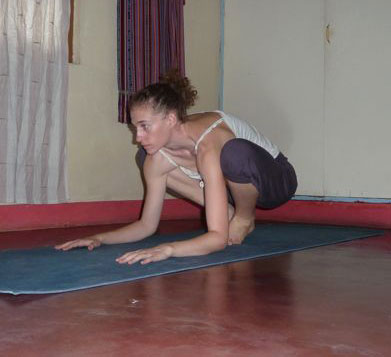
Desiree and Andrew teach it a bit differently.  First, they had us squat down with our feet touching and our hands shoulder width apart, like this:


We stayed here for a few breaths, focusing on hugging the knees against the back and outside of the upper arms and engaging the core to squeeze the knees in.

Then, we straightened the arms and walked the hands and feet closer together, still squeezing in, and finally coming up on tiptoes to come to a position like this:


From there, we kept pressing the knees firmly against the upper arms and practiced elevating one foot at a time, keeping the other safely on the ground:


And finally, we gently transferred more weight onto our hands and used our core muscles to lift the feet up!


For me, this method has two serious advantages.

1) There is much less knee slippage - hugging the knees in keeps the knees really nice and stable.
2) The preparatory position is almost exactly the same as the final position! Notice that the feet are together, and the back is rounded like child's pose, just like in the final expression of crow.  So all you have to focus on is lifting your feet.

The one disadvantage is that if you are not very open in the hips, the prepatory position can be a bit tricky.  To help with this, they suggested using a block or blanket under your feet, to elevate the feet a bit and reduce the load on your hips, like this: (a nice fat pillow in front of you also doesn't go amiss...).


Here's a shot where you can see how the two knee positions compare.  It's a subtle change in position but for me, it made a WORLD of difference.


Finally, remember that to come into bakasana from this position, you are not moving forward and down, as it might feel.  Your body is staying in almost the exact same place but your feet are lifting up.  So the gaze, or drishti in this pose is NOT the floor where you are afraid you are going to face-plant, but forward and upward as you hug your feet - one at a time, or both - up towards the mid-line.

Was this helpful to you? It sure was to me. :)  Have you ever had a "revelation" in a pose or a teacher that suddenly opened it up for you? I'd love to hear about it!

Tuesday, April 27, 2010

Yoga for Soldiers

My life here is a little bit out of the ordinary.  You got that, right?  Anyway, twice a week I teach yoga to small groups of (mostly) men from the defense forces who are here as peacekeepers.  Yep, yoga for soldiers.

Teaching the troops has been a really educational experience for me as a teacher.  After all, they are pretty much the polar opposite of my own body type: small, female, thin without much muscle.  And what's more, they are not exactly your average beginner Yoga students.  First of all, they have been training their bodies for years, so generally they are very physically aware.  And secondly, they follow instructions!  LOL.  By which I mean that they respond well to verbal cues about the body, which is a skill that it took me years to develop.

I feel that I'm pretty lucky: in addition to teaching the gents of the Oz and NZ army, my twice weekly group classes have also gone from being nearly all female to having an almost equal male to female ratio, mostly thanks to a bunch of keen helicopter pilots and body builders.

So, what are these guys looking for in a Yoga class?

In my experience, these men, who are relatively fit already, come to yoga because they are looking for flexibility and injury prevention.  The majority of my women students are after weight loss, muscle tone, strength and fitness - most of which these guys already have!  What these men suffer from are tight hamstrings, stiff shoulders and lower back issues, to name the most common.  Many of them have also been injured from intensive physical training, sports, or combat, so injury prevention and/or recovery is a big theme as well.

Most of them are runners and/or weight trainers, and some do short interval training.  So building lung capacity and breath awareness, increasing oxygen intake, and developing a longer physical routine can also be motivating factors for them.  As they progress through the practice, those that get into it will come to see yoga as a way of honing their strength in a more uniform way and developing balanced bodies with flexibility as well as muscle, as well as enhancing their focus and concentration during athletic activities.  For more ideas of what might motivate these athletic guys, have a look at this website, which is the site of a personal yoga trainer for elite athletes!  She provides a neat list of physical and mental benefits that athletic types can expect from yoga.

Teaching the Troops

I have found that my best approach is to focus first on the physical benefits and then to let the mental benefits slowly sneak up.  People who are generally very physically focused will probably be put off (at least at first) by a spiritual approach to yoga.  So I usually start a practice with breathing exercises instead of meditation, and finish with a guided mind-body-awareness practice instead of chanting.  We work on challenging the breath and building awareness of 3-part breathing, the role of the diaphragm and shoulders, and how to expand lung capacity.

Other things I have found in working with this demographic is that I have to hit the level of challenge just right.  On the one hand, they are much stronger and fitter than most beginning students.  So I will introduce strength poses fairly early on, such as Chaturanga Dandasana, Plank and its variations (one-armed, or plank with leg lifts or knee bends), Navasana and Bakasana, to keep them challenged.  Arm balances and standing balances are great because they require strength as well as balance and give that special sense of achievement or reward for your efforts - Bakasana is a good one because it doesn't require much flexibility in the hips, as many others do.  For standing balances I like Tree with arm variations like Eagle to challenge the shoulders, and also poses like Warrior III which require a lot of core strength and focus.  I have found that the guys are more than willing to try 'scary' things like Bakasana - and I have seen a few of them get it on the first or second go (and it took me only, oh, 4 years or so?!)!

On the other hand, my muscle-bound students need encouragement that yoga can be accessible for them despite their low flexibility.  So I generally don't try to push them with too many seated forward bends or postures that require flexible hamstrings or bendy backs, which can be really frustrating and discourage them because they won't see much progress even over a 6-week period, and may not stick with the practice.  Although I do insist on paschimottanasana and janu sirsasana, with the emphasis on lengthening the spine - knees bent if necessary - I also offer lying down hamstring stretches and hip openers so they can go deep into the hamstrings without compromising the lower back.

Because most of these guys have limited hip and shoulder flexibility, we work on those areas through the standing postures, with a heavy emphasis on alignment too.  Poses like extended angle pose, warrior I and II, lunges with both hands inside the forward foot, and the occasional supine pigeon are good hip-openers, and poses like utanasana, Prasarita Padotonasana and parsvottanasana can be done with hands clasped behind the back to open the shoulders.  For all forward bends I try to encourage them to keep their knees bent and emphasize lengthening the spine in order to protect the tight hamstrings and slowly open up the lower back. 

Being, if you will, a bunch of boys, these guys are prone to challenge each other and themselves, so I try to discourage their competitive edge by emphasising breath and drishti, and by reminding them over and over to respect their limits and not push too far.   I also find that warming up properly is extremely important to make sure that they are stretching with the minimum possible risk of injury, so we start the practice with lots of repetitions of sun salutations.

Mind Body Balance

Over time (sometimes not very much time!) the mental benefits of yoga will start to shine through.  These can include improved relaxation and sleep habits, heightened focus and concentration, better overall energy levels and mental alertness, and emotional stability are all in the list.  And yes, some of my longer-term muscle men now chant with gusto, hands in namaste and all.  :)

These mental benefits of yoga have led to it also being used to treat soldiers who suffer from post traumatic stress disorder, something Svasti blogged about yesterday, and something I found a short article about on this blog as well.

Your turn!

All in all it's been a great teaching experience for me and I've learned so much and am still learning.  Now, it's your turn....   Fellow teachers, what have been some body types you have learned a lot from working with?  Fellow students, what have you learned from people with different body types from your own?

Saturday, February 20, 2010

My amazing students: overcoming chaos and staying in the flow

On Fridays I teach a gentle flow class. It's my favourite class of the week - calm music, breath-focused flow - it even leaves me, the teacher, feeling refreshed!

This evening we had a bit of a 'special' class. First of all, we practice in a small conference room annexed to the back of a local NGO. For the past few weeks the air conditioners haven't been working properly and it has been HOT. Like, hot-yoga-hot, but the heat and humidity are 100% natural and you can't just turn them down or open a window! Said NGO office is adjacent to a local football (soccer) field, and today just before yoga class the inevitable happened: yes, you got it, ball through the window. Glass everywhere, chaos, and, yep, gaping hole for noise, mosquitoes and yet more humidity to come in through.

As we started our practice, the game next door continued, seeming louder than ever through the broken window. When the game finished, the guys decided to string up a net between the field and the NGO building. Great idea! Also, loud, chaotic and complicated idea which meant that we had 15 young guys standing on the wall in between the NGO and the field, shouting to each other, holding a net, trucking ladders back and forth, and yes, staring in at whatever-on-earth-the-wacky-foreigners-are-up-to-now: our Yoga class.

So there we are in our 100% humidity, mats sliding on tiled floor, mozzies buzzing, footballs flying, ladders clanging, boys shouting, and I am turning up the music and practically shouting
"stay with your breath"... And somehow, we manage to stick with it, somehow, we manage to stay in the flow. As we hit Savasana night falls, I turn off the lights, turn up the music, and finally find that teeny bit of stillness.

And then, after the class, one of the students comes up to me and says: "I think that was the best yoga class I've ever been to in my 60 plus years."

So this post is dedicated to my students. As I said to them tonight, they never cease to amaze and inspire me. There we are in our far-from-perfect conditions, and yet they keep coming, week in and week out, to practice Yoga. Here they are, far from home and family, from country and loved ones, living in the crazy uncertainty of this chaotic town and yet, they practice. They practice through sticky heat, power-outages, mosquito bites, broken glass, football games, and shouting youth. They come to practice through the dust and the heat, or wade through the muddy, flooded parking lot in torrential rain. Despite all the obstacles this place can throw at them, they practice. And THAT, I was reminded tonight, and reminded them, is Yoga.

Because life is unexpected. You never know what it's going to throw your way. It's not a smooth, easy road - it's a 4x4 obstacle course and the ride is going to be bumpy! Yoga is about self-discovery, and it is in facing adversity that we really learn about ourselves, it is how we deal with the challenges and the potholes that teaches us who we are and helps us to grow. And if we can keep a soft breath and a steady gaze amidst all the chaos - then truly, what can we not do?

Sunday, February 7, 2010

Adjustments: the magic of touch

This post was inspired by a lovely post over at Bab's Babble!

Adjustments - to give or not to give? - is a big topic among yoga teachers today. Perhaps it is our puritan heritage, but in Canada, America and Australia, touching strangers (or even friends) is not a big part of our daily lives. [Woe betide the traveller who goes to continental Europe and is faced with the barrage of face-kissing strangers!] So it's not surprising that many of us have trouble bridging this uncertainty in the yoga studio.

For me, verbal cues are the foundation of teaching - an adjustment is never a replacement for that. But physical adjustments are like the icing on top of the student-teacher exchange. As a teacher, I personally give a lot of adjustments for the simple reason that I love receiving them. I absolutely love feeling the strong, competent hands of a teacher helping me to expand my limits in a pose and taking my body to places I didn't think it would go. I quiver with happy anticipation when a teacher stops to connect with me and take my postures to a deeper place.

For me, touch is a very important resource as a teacher, and the student-teacher energy meld that takes place is one of the parts of teaching that I treasure most. It is one thing to tell someone to do something and totally another to feel under the palms of your hands the way in which their muscles move and to work with them in a pose. When you adjust someone you get a deeper sense of how their body works and that in turn enables you to give them better instruction. I also find that adjustments help me connect with my students individually, and give them one-on-one attention even in a group setting, which I think every student seeks from a teacher. For this reason I try to touch every student at least once during a session, even with a big group.

Here are some things I have learned about giving adjustments:
  • Every now and then remind people that they are not doing something "wrong" in order to receive an adjustment! but rather that you see their potential to do more in a pose. Say something like: "If I adjust you, it means that you're doing something right, and I'm just helping you to explore it a bit further." A lovely teacher friend of mine bypasses negative perceptions by calling them "assists" instead.
  • Never go straight to a new student - let them see other students getting adjusted first. Always start with a simple "feel good" adjustment like Child's Pose or Supine Twist until they become comfortable with your touch and you feel confident adjusting them.
  • Body language is a big indicator of whether or not people will be receptive to a 'big' adjustment. Watch them carefully as you approach and if the student seems unreceptive, use a verbal cue or a simple touch instead.
  • Always follow up an adjustment or verbal cue with encouragement: "very nice", "great", "beautiful", "well done", so that the student feels they are getting something for what they are giving!
  • Instruct their breathing ("inhale - lengthen", "exhale - soften") as you adjust and ask how the pressure is to get a sense of how they are feeling in the pose.
  • Even the most advanced students can benefit from an adjustment - don't avoid them. Fellow teachers are probably especially likely to enjoy a good assist - and if taking a fellow teacher's class, encourage them to return the favour!
  • Be mindful of the other student's time when giving an adjustment. Occasionally you get distracted helping someone and leave the rest of the class in a pose for far too long! With experience you get a sense of how long to adjust the student while still leaving yourself time to get back to the front of the class for the next pose.
And finally, remember that giving adjustments requires training and practice. Don't guess - KNOW what you are doing and how to do it. Learn how to use your hands in an appropriate, non-sensual way and how to give adjustments to sensitive areas of the body, including thinking about when you need to ask someone's permission. Know which parts of the body you should (muscles) and should not (joints) touch. When learning a new adjustment, always practice first on a willing yoga-friend who can give you feedback on things such as pressure and placing of your hands and body.

My absolute favourite adjustments (NB these are vague descriptions only and not intended as instruction on how to give the adjustments!) to give include:
  • Downward-facing Dog: Standing in front of the student and pressing back on the sacrum. Alternately since I am very small, on larger students especially men, I stand behind them and bring a strap around their mid-thighs, then lean my weight back against the strap. Both of these help bring tension off the arms, lengthen the spine, and work the weight onto the heels.
  • Child's Pose: simultaneously press down on the sacrum and forward and down between the shoulders, lengthening the spine.
  • Twists: You can always get deeper in a twist with someone giving you a helping hand!!
  • Halasana: I love the way people gasp in surprise as their feet touch the floor behind them for the first time, with only minimal guidance. I love this one because people really feel a sense of 'accomplishment' after this adjustment and next time will be confident to try it on their own.
A great resource for adjustments is Stefanie Pappas' "Yoga Postures Adjustments and Assisting" - lots of photos and great explanations of verbal cues as well as hands-on adjustments.

So what do you think folks? As a teacher, do you give adjustments? As a student, do you like receiving them? And what are your favourites to give or receive?

Friday, December 18, 2009

The Seat of a Teacher

All the discussion online and elsewhere about regulating teacher training programmes has got me thinking: what, really, is a teacher? How do you become one? Who are the best teachers?

I became a yoga teacher by accident. No, really! Out of the blue one day I was asked to lead a small group of yogis, after our teacher left. So I did - and I found that I loved it! Three years later, I finally decided to pursue a teacher training. I guess I did this for two reasons - firstly, to challenge myself to take my yoga knowledge and practice to the next level. And secondly, out of a realisation of responsibility towards my students - especially the responsibility to their safety.

When you put yourself in the seat of the teacher, people innately trust you. In a yoga class, people get into the flow of following instructions. They try things they wouldn't normally (like touching their toes!). And everyone's body is different - I can do something without pain that might injure another person.

So a teacher is someone you trust. In Yoga, you trust your teacher physically to guide you safely through the postures. There is also an ethical dimension to this: you trust your teacher to be professional, to touch you appropriately, to make you feel safe and respected.

A teacher should do this because a teacher is someone who is there for YOU. S/he is not there to hear herself speak. S/he is not there to do her own practice or to show off her asanas. S/he is not there to judge you, gossip about you, or flirt with you.

A teacher is someone who shows you the road, gives you the keys, but lets you drive there at your own pace. A teacher wants you to succeed for your own sake - not for how it will reflect back upon them. A teacher gives you a map but doesn't just hand you the treasure.

Teachers are a gift, and sometimes a surprising one at that. They appear in your life out of nowhere, sometimes staying only a moment, sometimes staying with you forever. If you are open to it, almost anyone can teach you something. :) And maybe without even knowing it, you are teaching people all the time.

So, what does it take to sit in the seat of the teacher? Honesty. Courage. Faith. Humility. A sense of humour!

Please add to this list...

Thursday, June 25, 2009

5 weeks to go...

In 5 weeks today my teacher training starts!!! It's pretty scary but at the same time I think I will be as ready as I'll ever be. I've been practicing almost every day for the past few months, teaching twice a week, and recently I started taking classes 3x a week at lunchtime.

Taking classes again has been an amazing experience. It was really serendipitous that I found these classes just as I'm preparing for my training. My teacher is a very experienced Yogi, a brand apart from the usual drop-in studio teachers who are not significantly older than I am. This teacher has maturity and many years of a dedicated practice. He pushes us to completely new understandings of poses while making sure that we maintain rigorous attention to the form of poses. He makes us take our time coming in so that we pay in-depth attention to our alignment and muscular activation in each pose - and then once we're there, he helps us to explore each pose deeply.

In English that translates as: "ouch"!! :) In a "oh, I have muscles there I never even knew about until I felt them every time I moved? This had sure better make me grow as a person..." kind of way.

It makes me feel again like I felt when I first came to Yoga, when I'd walk out of pretty much every class with the above sentiments. It also makes me realize the areas in which I've been lenient in my own practice. With a home practice it is so easy to be unaware of the things you're doing wrong or to ignore the poses you aren't as good at. It's easy to get egotistical, thinking "oh, yeah, I've got that pose down". But a good teacher reminds you that you've never "got a pose down". Even in perfect alignment you can always put more energy or effort into a pose, explore it more deeply, feel it more fully, or at the very least, be more connected to your breath.

So, the countdown has really started... Every day I'm trying to be a better teacher, but I'm finding it difficult to strike the right balance between giving good instructions for each pose, and keeping the class moving at a good pace. How do you 'slow down' your teaching enough to really help students get the most out of each pose, without slowing down the class too much? How much instruction is enough?