Saturday, March 9, 2013

Confessions of a yoga grump

I have a confession to make. You see, I seem to have a problem. Sometimes, I start to frown. I get upset. In fact, I get downright cranky! It makes me feel like I'm a lot like this guy, and just as much fun to be around:

At which point my lovely partner - a truly patient soul - generally says something like "why don't you do some yoga, sweetie?"

Yes, it's true... I'm a yoga grump! By which I mean that when I don't do yoga, I get grumpy! Apparently yoga should come with a warning label: "Highly addictive. If withdrawn from yoga, the yogi may suffer from grumpiness, aches and pains, mood swings, loss of motivation, couch-potatoness, too much TV, and other symptoms of withdrawal."

The only cure: more yoga! Yoga, almost daily, morning, noon or night. 5 minutes, 50 minutes, or an hour and 50 minutes. Yep, a cup of yoga a day keeps the grumpy bear away!

Yogis, does this happen to you?

Wednesday, March 6, 2013

Yoga Tip Tuesdays: Helpful Hints on Stepping Forward From Downward-facing Dog

I love it when people a) comment on my blog, b) find my blog posts useful, and c) ask for particular things on the blog! Please don't hesitate to let me know if these posts are useful (or not!) to you and just leave a comment if there is something you'd like me to post about!!


~~~~~~~~~~~~~~~~~~~~~~~~~~~~~~~~~

On my post about transitioning your toes through the sun salutations, Lynn, a reader, commented: "I am a yoga teacher as well, and have always struggled with both jump to the top of my mat, or to smoothly step forward, do you have any helpful tips for this?"

This is SUCH a good question!! Being able to smoothly move from the back to the front of the mat might look simple, but (as so often in yoga!) it's actually a fairly difficult move for the majority of people. So, whether you are a teacher or a student, it's a very good thing to be able to break down this motion, and to teach it to people of all abilities.

There has been a lot written and demonstrated on the internet about jumping or "floating" forward, and it is a demanding move that I generally don't teach in classes (too much risk of injury when done sloppily) so I'm not going to focus on that. 


Instead, let's have a look at Stepping Forward

If you go to a vinyasa-like yoga class, you will probably hear these words at least 20 times per class: "now step your foot between your hands, and..." Well, for many people, this is easier said than done! If you're not convinced, imagine replicating this move while standing with your palms pressed against a wall! Ok, convinced now?

A little anatomy

Stepping your foot forward from downward facing dog requires a couple of things to happen.  In order for you to lift and bend your knee, your psoas and hip flexor have to strongly engage.  Your psoas is super strong and used to this - it's what it does every time we take a step forward when we are walking!  However, once your hip is fully bent (when your knee comes in towards your body), your psoas can no longer generate any force, which is why we tend to lose momentum half way through. Once you pass that critical point, the weight of the movement must pass from the legs to the arms; with the back, shoulders and core muscles helping to keep lift. Finally, the hamstring has to lengthen and the quadricep engages to bring the bent knee down to the floor and take the weight of the body back to the feet.


The sequence

For this yoga tip, I'm offering a few simple movements that re-create the elements of stepping forward. If we work on those individually, the overall movement will gradually become easier!

1. Nose-to-knee stretch


(click for larger image)

Variation 1

Lie on your back with your hands and feet on the floor. Slowly, without using your hands, bend your right knee and bring it all the way up to your chest. Grab your right knee with your hands, and meanwhile keep your left leg strongly engaged, trying to press the back of your left thigh into the floor.

Next, as you exhale, warm up the core by drawing your nose towards your knee. Try not to use your hands, but instead press the belly back down into the ground and curl up from the core. Inhale, coming back down. Repeat 5 times, optionally holding the last repetition for 3-5 breaths.

Variation 2

This time, try the above exercise with the leg straight.  This stretches out the hamstring, while also bringing an extra stretch to the hip flexor of the grounded leg.

When you've done the right side, repeat on the left.


2.  Cat / cow variation and 3-legged dog variation


(click for larger image)


Come up to all fours. As you inhale, raise your right leg (with the knee bent) behind you. As you exhale, lift your belly button up towards the ceiling, arch your spine, and draw your knee as high as you can towards your chest, and bring your nose in towards your knee.

Repeat this 5 times, and on the 5th repetition try to hold the exhale position for 3-5 breaths. Then do the other side.

The 3-legged dog variation is similar to the cat/cow variation, except in downward-facing dog. As before, on an inhalation lift your right leg up behind you, keeping your hips square. As you exhale, lift up from the core, bring your shoulders over your hands, and hug your knee up towards your chest. Next inhale, lead with the leg and push back.

Repeat this 5 times, and on the 5th repetition try to hold the exhale position for 3-5 breaths.


3. Stepping forward

When the exercises above feel smooth, try stepping forward. Begin just as if you were going to repeat the 3-legged dog exercise, above. This time, when your shoulders come over your hands, use the momentum to lengthen from the hamstring and push from your quad to bring your foot down onto the floor between your hands. If your foot doesn't come all the way, gently walk it to the right place.

As you practice this movement, remember to:
  • Compress the hip flexors on the front leg while keeping the front of the back thigh long and strong, like in nose-to-knee stretch
  • Lift the belly button up towards the spine and the backs of the shoulders strong, like in the cat/cow variation
  • Lift your knee high towards your chest and shift your weight all the way forward onto your hands, like in 3-legged dog
  • Look forward and visualise where your foot should land!! Where you gaze goes, your body - eventually - will follow.
Once your front foot is there, pause, transfer your weight to the forward foot,  and repeat a similar motion with the back leg: lifting up, bending the knee, and gently placing the foot on the floor.  Remember to be patient, breathe deeply, and try not to be attached to the results of the exercise - it's the practice that counts!


~~~~~~~~~~~~~~~~~~~~~~~~~~~~

If you've read this far, I'd love your feedback! Was this tip helpful? Is there anything else you'd like tips about? Leave a comment!

Sunday, March 3, 2013

Why yoga is not a religion


re·li·gion  
/riˈlijən/

NOUN

  1. a set of beliefs concerning the cause, nature, and purpose of the universe, especially when considered as the creation of a superhuman agency or agencies, usually involving devotional and ritual observances, and often containing a moral code governing the conduct of human affairs.
  2. a specific fundamental set of beliefs and practices generally agreed upon by a number of persons or sects.

I am not sure why this continues to be a controversial discussion point, as it is really very clear if you stop to think about the definition of a religion. But in light of my recent post about staying true to the philosophical roots of yoga, and in light of conversations going on elsewhere in the yoga blogsphere, here are 4 reasons that, for me, make it vividly clear that yoga is not a religion.


yo·ga

  1. Does not in any way pertain to the cause, nature, or purpose of the Universe, nor does it propose any theories about how it was created. Wait, isn't that what science does?
  2. Has no specific or fixed theological perspective. It does not specifically recognise a deity, nor does it deny the existence thereof. It's theological openness means that it cannot BE a religion in itself, but neither does it demand that people are with or without religion - basically, you are free to devote yourself to a superhuman force or being, if that works for you, or you are free to concentrate purely on your inner experience, if that works for you.
  3. Does not prescribe one or more fixed paths: it explicitly recognises that different people may take different paths and even proposes many different ways for individuals to try. Much like the scientific process of trial and error, yoga allows us each to find what works for us, and doesn't make any judgements about which way is correct or "better".
  4. Emphasises individual practice and experience, not doctrine or belief.  In yoga, it's not enough to hear or to believe - realisations must be experienced. The individual seeker must cultivate understanding based on questioning one's feelings, beliefs, actions and assumptions, and we are free to find answers to those questions from within or from a divine source or scriptures - or to not find answers at all. There are no prescribed findings - only suggested techniques for inquiry. 

So, let's be clear, outrageously ill-informed online dictionaries: Yoga is NOT a "Hindu discipline". It is a discipline which originated in India, yes. So is Buddhism, by the way, and Jainism, and the Beatles' White Album.  It is a discipline in which you are free to be Hindu, Christian, Athiest, Muslim, Jewish, or none of the above, because it is based on the questions, not on the answers.


phi·los·o·phy  

/fəˈläsəfē/

NOUN
  1. the study of the fundamental nature of knowledge, reality, and existence, esp. when considered as an academic discipline.

Although the yoga tradition can be traced to the Vedantic culture in India circa 3500 BCE (known as the Indus Valley Civilisation), the yoga theory that we know today is mainly based on the Yoga Sutras of Patanjali, which were written around 200 CE. Don't get fooled by the sanskrit name! As discussed above, the Yoga Sutras don't set out any theological principles. Rather, they outline a philosophical problem, and propose a solution. It goes sort of like this:

  • The human experience is characterised by discomfort and suffering. We just aren't happy, which is a bummer.
  • The good news is that this suffering is kind of like seeing the glass half empty: if we are able to overcome the confused states of the mind (the citta-vrtti-nirodhah) that cause us to dwell in suffering, we can shift our perspective and alleviate our predicament.  It's like that scene in Robin Hood: Prince of Thieves, where Little John thinks he's drowning and yields to Robin, who then "saves" him by telling him to simply stand up - he was so overwhelmed by the fear of drowning, that he nearly drowned in water he could actually stand in.
  • There are two fundamental states in the human experience, prakriti, the "seen", i.e. the ego-self that is basically completely self-obsessed (and likely to drown in misunderstanding), and purusha, the "seer", or the higher self / true self / inner self, that is able to inquire deeply and see things the way they really are (for example, that the water is not actually that deep).
  • People are unhappy because we over-identify with the ego: we live constantly chasing the desires and fluctuations of the ego, chained to the idea that one day, achieving all these desires will "make us happy".
  • Being obsessed with the ego, the true self becomes suppressed, neglected, and forgotten. We subsume the desires of the true self to those of the ego-self, like in a co-dependent relationship, instead of creating a healthy, balanced relationship by nourishing both parts of ourself.
  • When we are living from the ego-self, we act in misguided ways, pursuing self-gratification, bouncing between the extremes of clinging to some things and despising others, and living in a desperate desire to hold onto life. We think that these actions will make us happy, but instead, our unwise thoughts, actions and words plant the seeds of themselves, and lead to more unwise actions, in a vicious cycle.
  • However, if we cultivate things that make our true self happy, if we instead plant different seeds, we can transform our experience, because those seeds will grow and take root instead, and lead to more actions, thoughts and words that make us happy, until eventually they no longer require effort, but become effortless. (Science nuts, see neuroplasticity and habit formation).
  • Yoga proposes the yamas (restraints) and the niyamas (constructive actions) to help guide us towards these positive actions, and away from the misguided or ego-centric ones.
  • To help "awaken" or "liberate" our mind (so that it can realise that the water is actually shallow), yoga proposes a variety of techniques including awakening and focusing the energy the body (asana), breath-work (pranayama), concentration (pratyahara), and meditation (dharana, dhyana, and samadhi). Together with the yamas and niyamas, these form the solution to the problem of our self-percieved suffering.
  • Even when you have attained this 'liberated' state, the world continues to be as it is, and you continue to be in the world. You don't evaporate in a puff of smoke or rise up to sit on a luminous cloud. Only your suffering dissolves. You cease to be "tied down" by what your mind believes is real, and you become 'liberated' from the constraints of a limited (ego-bound) perspective. And that is what happiness is - freedom from our own imaginary limitations, by recognising that we are more than our ego-experience.

So, yoga is not a religion. 

Yoga is a TECHNIQUE to reduce our experience of suffering, based on a philosophy about the nature of the human condition.


The technique can be applied against any theological or a-theological background. The only fundamental assumption is that every individual has the ability to reach a state where they are happy and free.


Saturday, March 2, 2013

Foodie Fridays: 2 Great Mushroom Recipes, and some Ayurvedic musings

Anyone who has done a bit of study on Ayurveda (the yogic food & lifestyle science) will know that mushrooms are a bit of a controversial food. Classically, Ayurveda  classifies mushrooms as tamasic (err, roughly translating as 'rotten', although the gunas are much more complex than that), advise us therefore not to eat them, and then pretty much moves on. On the other hand, just over the border in China, many edible mushrooms (for instance, shitake) are classically considered to be excellent foods and to have medicinal properties. So what gives?

When I asked my Ayurveda teacher about this, she quipped that, well, they are a fungus and don't grow in sunlight so they can't be considered sattvic, but probably some sage of long ago ate a poisonous mushroom in the forest with bad results, wrote it down, and next thing you know, "no mushrooms". Of course, her anecdote has a definite ring of truth: people today still die of mushroom poisoning, and in the days before supermarkets, the ayurvedic advice to avoid mushrooms entirely was probably excellent counsel for those gathering food in the forests of India.

Thankfully (for mushroom lovers like me, anyway!), modern ayurvedic doctors are opening their minds, and their kitchens, to mushroom consumption. Many now consider mushrooms to be a nutritious and tasty supplement to a vegetarian diet. Mushrooms, being moist and cool, would generally be considered to reduce Vata and Pitta, but to augment Kapha dosha (people of that type should favour the dried varieties to lessen this effect).  Overall they are still tamasic, so they should be eaten absolutely fresh, and considered as an addition to your diet as opposed to a staple. Also their moist and heavy qualities might make them difficult to digest for those with more sensitive systems, so careful spicing and flavouring is definitely recommended.

So, readers, if your mouths are now watering for mushrooms, here are two fresh and delicious recipes that I have enjoyed recently! The best part is they are both super quick and easy!


1. Fresh Mushroom Soup


I found this recipe from Jamie Oliver but it was a bit fancy, so I adapted it as below. With the quantities I used it made about 3 hearty servings and it was unbelievably delicious! The lemon zest really made the soup come alive, so definitely try it!

- Chop 4 large portabello mushrooms and 2 handfuls of brown mushrooms. Also prepare an onion and some garlic, to taste
- Add some olive oil to a large pot, and throw in the onions and garlic; when they are soft, add the mushrooms
- Cook until the mushrooms are juicy and then add 3 cups of veggie stock and a lot of fresh thyme.  Simmer about 20 minutes.
- Blend the soup in the blender and then put it back in the pot.
- Add 2 tablespoons of cream cheese if you want to make the soup creamier
- Combine: the zest of 1 lemon, the juice of 1/2 lemon, and a pinch of salt and pepper

Serve the soup, then pour some of the zest mixture into the centre of each bowl and top with parsley. Stir the zest through, and enjoy - YUM!


2. Herby Mushroom Pasta with Mustard Sauce


This is based on a recipe that we found on BBC Good Food (who knew?!), but I added spinach to the sauce, which was super tasty. Plus, the tri-coloured (gluten free!) pasta made it fun and colourful, AND it only took about 20 minutes from start to finish.

Basically, while the pasta is cooking:
  • Take about 2 big handfuls of field mushrooms or 1-2 portabello mushrooms (the recipe says 250g, however you're supposed to figure that out) and chop them thickly
  • Optionally, chop 1-3 cloves of garlic, to taste (I don't think it really adds much to the recipe, but it does smell good as its cooking)
  • Throw them into a frying pan with about a  1/2 cup of vegetable stock and 2 teaspoons of wholegrain mustard
  • Stir and simmer until the mushrooms are soft and the stock is nearly gone
  • Roughly chop 3 big handfuls of spinach leaves (and stems if you like them) and add to the mushrooms
  • When the spinach is cooked (how cooked is up to your taste!), turn off the heat, toss in the pasta, and add a handful of parsley (or other tasty herb) and the zest of a lemon, and then serve!


Readers, do you eat, or choose not eat, mushrooms? Share your recipes here! :)

Wednesday, February 27, 2013

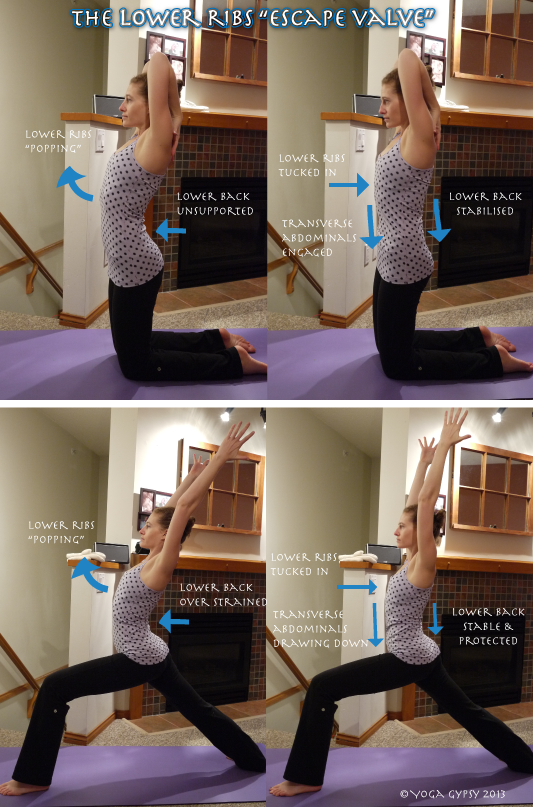
Yoga Tip Tuesdays: The Lower Ribs "Escape Valve" - A Simple Tip for Back Stability

Today's Yoga Tip is a short but sweet one that will help you to be more precise in your alignment, activate the transverse abdominals, go deeper into the backs of your shoulders, protect your lower back, and improve your overall core stability.

Many of us, when we do yoga, "think" with the front of our bodies. So when we are asked to open the back of our bodies, we unconsciously try to manifest the instruction on the front body.  In some cases this is simply because our minds aren't used to thinking about the back of the body (out of sight, out of mind!). Or we may have tightness in the back body, and so we try to compensate with the front body.

The example I want to look at today is a common one: when working to stretch the backs of our shoulders, or when moving into a backbend, we lengthen our spine, lift our collarbones, and let our lower ribs "flare" or "pop" out. It feels like we are stretching more deeply when we do this, but in fact we are using our ribs as an "escape valve" to compensate for tightness in our back body.

So, what's the big deal? Well, when this "escape valve" becomes a habit, you will carry it with you throughout your practice, including into more challenging poses like backbends.   When the lower ribs are "popped", your lower back isn't being stabilised by its synergists, the transverse abdominals. This can cause excess load to be carried by the lumbar spine (the lower back), which can possibly lead to strain or injury.  You want to be especially careful of this if you (like me) tend towards a "curvy" lower back in general, because it can also mean that your back is taking undue strain even in postures that are not backbends (and probably in your day-to-day life, as well).

In either case, this is really simple to correct once you're aware of it: use your abdominals to pull the lower ribs back in and down and keep them close to your body. Then go back into the pose, staying aware not to let your ribs flare out again.

Clear as mud? Have a look at the pictures!


~~~~~~~~~~~~~~~~~~~~~~~~~~~~

If you've read this far, I'd love your feedback! Was this tip helpful? Is there anything else you'd like tips about? Leave a comment!

Saturday, February 23, 2013

How I Help Perpetuate The Modern Yoga Narrative


Someone marvellous shared this funny little graphic on Facebook, and it made me laugh out loud. Which is it's own form of yoga, by the way.  It also made me think, on a deeper level, about that question of why we go to yoga, and how what was once an exclusive and sacred (not necessarily good things) discipline of spiritual seeking has become boiled down in our minds to one word: "flexible".  Whence this post....


~~~~~~~~~~~~~~~~~~

Now that yoga is fantastically popularised and pretty much mainstream, the average modern yoga student probably isn't familiar with the roots of yoga, beyond knowing that it originated in India a long time ago (like, when movies where still in black and white? ;) ). Many probably remember from their parents' generation of yoga that it had some kind of a spiritual component, but our generation doesn't like having "foreign" spiritual ideas thrown at us when we go to a public space. We prefer billboards, commercials and glossy magazines telling us what the world is all about, thanks, telling us what to value, and what we are worth. We fervently defend our right to not to learn about alternative philosophies unless we deliberately choose to (it's such a chore), as opposed to considering it our right (duty) to deeply examine the many facets of an issue before making a decision. No, we prefer to make decisions first, generally in the time it takes to "like" something on facebook, and our world rewards us for having the strength of character to simplify life into clear-cut dichotomies upon which we can make snap decisions and express strong opinions. (Is it any wonder politics is f$^@#*ed??)

In any case, I won't be the first or the last writer to comment on the disconnect between the roots of yoga as an integrated practice (mind - body - breath) and the narrative of modern postural yoga. Nor will I be the first or last to conclude that hey, to each their own, and if more people are doing yoga, then great, and there's nothing wrong with just doing asana to stay healthy (or bend yourself into a pretzel, or just feel good) and that being the end of it.

And to be honest with myself, and you, as a yoga teacher I play my own part in perpetuating the dominant narratives about yoga. In my classes, I teach 95% asana and only 5% pranayama. Sometimes I teach "fancy" postures. My cues and explanations focus mainly on the physical body, peppered with frequent reminders to breathe, and smile, and "be present". Most of my students, even my long-term ones, don't know about the koshas, or the doshas, or prakriti and purusha, or moksha, or any of the other fundamental building blocks that shape the yogic worldview.

Yet not only do I know a bit about these concepts, but I relate to them, enjoy thinking and talking about them, and believe they offer a valuable perspective, one that is much needed in the modern world. So why do I help perpetuate the modern yoga narrative in all its bland, asana-focused-ness?

The truth is, I'm lazy. There is only so much time in a yoga class, and I have a cleverly designed sequence to get through, and still leave time for a long savasana.

The truth is, I'm concerned what my students will think. I believe they come to yoga expecting a work-out, and generally a tough one, at that, and I'm afraid that if I don't give it to them, they won't come back, they won't like me.

The truth is, my students paid for an asana class, not a philosophy class, and that's what I feel like I need to give them.

The truth is, I had to sign a contract agreeing not to preach my own personal philosophies during yoga class. Really. I did.  Edited to add: this is fair enough! It would be wrong to use my privileged position as a yoga teacher to tell others what to think or believe. But, where is the line between discussing yoga philosophy and "preaching a personal belief"? Some people are offended at even the use of sanskrit in a yoga class - in any case, it makes me nervous.

The truth is, my own practice is pretty much asana dominated, my meditation and pranayama having somehow slipped out and not quite been put back in.

And so I go, and I teach, and I practice, and I perpetuate the modern yoga narrative, all the while knowing that it doesn't satisfy me.

*It doesn't satisfy me.*

But I smile and stand in front of a class, and perpetuate the narrative, because that is what's expected (obligated?) of me and because that's what I know how to do.

Yet I believe that there is a space in a yoga studio for honest conversation. A space for education that goes beyond the physical. For the exchange of points of view, the discussion of complex concepts that can't be resolved in the time-it-takes-to-click-like-on-facebook.

A space where people are willing, have the courage, are thirsty to go beyond the physical and examine, re-examine, their relationships with themselves and the world. 

I believe in that space - and that I can play a part in creating it. That I must help to create it, each time I step onto the mat.

Readers, what do you think?

A Foodie Friday: Super Soups!

Dear readers, I apologise for the sporadic posting of late. I've been busy skiing, teaching yoga, skiing, and cooking yummy, hearty, fresh meals.

The old saying "you are what you eat" has never rung more true for me than now. My yoga practice has certainly played its part building my awareness to what I'm putting in my body. I also believe that my practice has made me more sensitive to "junk" and to foods that my body just doesn't tolerate, like wheat, which is of course a mixed blessing although a good thing overall.  Hmmmm. More on that some other time.

But now, back to the main event: some super yummy soups that are easy to make, use fresh ingredients, and will fill you with warm goodness on a cold winter's day.


1. Cream of Broccoli Soup with Coconut Milk, from the Gluten Free Goddess

A delicious, creamy soup that is gluten-free AND dairy-free? Be still my taste buds!  A bit of spice really livens up this soup and works so well with the coconut.


2. Lentil and Sweet Potato Soup, here at lcbo.com

This delicious soup is hearty, tasty, and mixes spicy and sweet in a surprising and delicious way!


3. Creamy Celery and Potato Soup, from The Daily Green

Well, I am a HUGE lover of celery so it goes without saying that I loved this blended soup.  It's fabulously creamy without using any dairy. I substituted veggie stock for the chicken, and voila!


Readers, what are your favourite soups to warm you up on a winter's day?