Wednesday, February 27, 2013

Yoga Tip Tuesdays: The Lower Ribs "Escape Valve" - A Simple Tip for Back Stability

Today's Yoga Tip is a short but sweet one that will help you to be more precise in your alignment, activate the transverse abdominals, go deeper into the backs of your shoulders, protect your lower back, and improve your overall core stability.

Many of us, when we do yoga, "think" with the front of our bodies. So when we are asked to open the back of our bodies, we unconsciously try to manifest the instruction on the front body.  In some cases this is simply because our minds aren't used to thinking about the back of the body (out of sight, out of mind!). Or we may have tightness in the back body, and so we try to compensate with the front body.

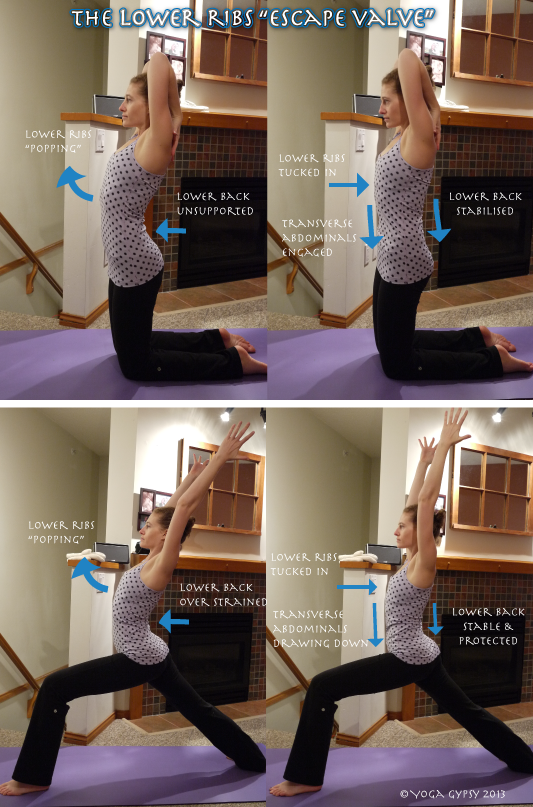
The example I want to look at today is a common one: when working to stretch the backs of our shoulders, or when moving into a backbend, we lengthen our spine, lift our collarbones, and let our lower ribs "flare" or "pop" out. It feels like we are stretching more deeply when we do this, but in fact we are using our ribs as an "escape valve" to compensate for tightness in our back body.

So, what's the big deal? Well, when this "escape valve" becomes a habit, you will carry it with you throughout your practice, including into more challenging poses like backbends.   When the lower ribs are "popped", your lower back isn't being stabilised by its synergists, the transverse abdominals. This can cause excess load to be carried by the lumbar spine (the lower back), which can possibly lead to strain or injury.  You want to be especially careful of this if you (like me) tend towards a "curvy" lower back in general, because it can also mean that your back is taking undue strain even in postures that are not backbends (and probably in your day-to-day life, as well).

In either case, this is really simple to correct once you're aware of it: use your abdominals to pull the lower ribs back in and down and keep them close to your body. Then go back into the pose, staying aware not to let your ribs flare out again.

Clear as mud? Have a look at the pictures!


~~~~~~~~~~~~~~~~~~~~~~~~~~~~

If you've read this far, I'd love your feedback! Was this tip helpful? Is there anything else you'd like tips about? Leave a comment!

Saturday, February 23, 2013

How I Help Perpetuate The Modern Yoga Narrative


Someone marvellous shared this funny little graphic on Facebook, and it made me laugh out loud. Which is it's own form of yoga, by the way.  It also made me think, on a deeper level, about that question of why we go to yoga, and how what was once an exclusive and sacred (not necessarily good things) discipline of spiritual seeking has become boiled down in our minds to one word: "flexible".  Whence this post....


~~~~~~~~~~~~~~~~~~

Now that yoga is fantastically popularised and pretty much mainstream, the average modern yoga student probably isn't familiar with the roots of yoga, beyond knowing that it originated in India a long time ago (like, when movies where still in black and white? ;) ). Many probably remember from their parents' generation of yoga that it had some kind of a spiritual component, but our generation doesn't like having "foreign" spiritual ideas thrown at us when we go to a public space. We prefer billboards, commercials and glossy magazines telling us what the world is all about, thanks, telling us what to value, and what we are worth. We fervently defend our right to not to learn about alternative philosophies unless we deliberately choose to (it's such a chore), as opposed to considering it our right (duty) to deeply examine the many facets of an issue before making a decision. No, we prefer to make decisions first, generally in the time it takes to "like" something on facebook, and our world rewards us for having the strength of character to simplify life into clear-cut dichotomies upon which we can make snap decisions and express strong opinions. (Is it any wonder politics is f$^@#*ed??)

In any case, I won't be the first or the last writer to comment on the disconnect between the roots of yoga as an integrated practice (mind - body - breath) and the narrative of modern postural yoga. Nor will I be the first or last to conclude that hey, to each their own, and if more people are doing yoga, then great, and there's nothing wrong with just doing asana to stay healthy (or bend yourself into a pretzel, or just feel good) and that being the end of it.

And to be honest with myself, and you, as a yoga teacher I play my own part in perpetuating the dominant narratives about yoga. In my classes, I teach 95% asana and only 5% pranayama. Sometimes I teach "fancy" postures. My cues and explanations focus mainly on the physical body, peppered with frequent reminders to breathe, and smile, and "be present". Most of my students, even my long-term ones, don't know about the koshas, or the doshas, or prakriti and purusha, or moksha, or any of the other fundamental building blocks that shape the yogic worldview.

Yet not only do I know a bit about these concepts, but I relate to them, enjoy thinking and talking about them, and believe they offer a valuable perspective, one that is much needed in the modern world. So why do I help perpetuate the modern yoga narrative in all its bland, asana-focused-ness?

The truth is, I'm lazy. There is only so much time in a yoga class, and I have a cleverly designed sequence to get through, and still leave time for a long savasana.

The truth is, I'm concerned what my students will think. I believe they come to yoga expecting a work-out, and generally a tough one, at that, and I'm afraid that if I don't give it to them, they won't come back, they won't like me.

The truth is, my students paid for an asana class, not a philosophy class, and that's what I feel like I need to give them.

The truth is, I had to sign a contract agreeing not to preach my own personal philosophies during yoga class. Really. I did.  Edited to add: this is fair enough! It would be wrong to use my privileged position as a yoga teacher to tell others what to think or believe. But, where is the line between discussing yoga philosophy and "preaching a personal belief"? Some people are offended at even the use of sanskrit in a yoga class - in any case, it makes me nervous.

The truth is, my own practice is pretty much asana dominated, my meditation and pranayama having somehow slipped out and not quite been put back in.

And so I go, and I teach, and I practice, and I perpetuate the modern yoga narrative, all the while knowing that it doesn't satisfy me.

*It doesn't satisfy me.*

But I smile and stand in front of a class, and perpetuate the narrative, because that is what's expected (obligated?) of me and because that's what I know how to do.

Yet I believe that there is a space in a yoga studio for honest conversation. A space for education that goes beyond the physical. For the exchange of points of view, the discussion of complex concepts that can't be resolved in the time-it-takes-to-click-like-on-facebook.

A space where people are willing, have the courage, are thirsty to go beyond the physical and examine, re-examine, their relationships with themselves and the world. 

I believe in that space - and that I can play a part in creating it. That I must help to create it, each time I step onto the mat.

Readers, what do you think?

A Foodie Friday: Super Soups!

Dear readers, I apologise for the sporadic posting of late. I've been busy skiing, teaching yoga, skiing, and cooking yummy, hearty, fresh meals.

The old saying "you are what you eat" has never rung more true for me than now. My yoga practice has certainly played its part building my awareness to what I'm putting in my body. I also believe that my practice has made me more sensitive to "junk" and to foods that my body just doesn't tolerate, like wheat, which is of course a mixed blessing although a good thing overall.  Hmmmm. More on that some other time.

But now, back to the main event: some super yummy soups that are easy to make, use fresh ingredients, and will fill you with warm goodness on a cold winter's day.


1. Cream of Broccoli Soup with Coconut Milk, from the Gluten Free Goddess

A delicious, creamy soup that is gluten-free AND dairy-free? Be still my taste buds!  A bit of spice really livens up this soup and works so well with the coconut.


2. Lentil and Sweet Potato Soup, here at lcbo.com

This delicious soup is hearty, tasty, and mixes spicy and sweet in a surprising and delicious way!


3. Creamy Celery and Potato Soup, from The Daily Green

Well, I am a HUGE lover of celery so it goes without saying that I loved this blended soup.  It's fabulously creamy without using any dairy. I substituted veggie stock for the chicken, and voila!


Readers, what are your favourite soups to warm you up on a winter's day?


Tuesday, January 29, 2013

Yoga Tip Tuesdays: Rolling your toes over in the transition to upward-facing dog

I love it when people a) comment on my blog, b) find my blog posts useful, and c) ask for particular things on the blog! Please don't hesitate to let me know if these posts are useful (or not!) to you and just leave a comment if there is something you'd like me to post about!!


~~~~~~~~~~~~~~~~~~~~~~~

This post is in response to a reader comment - yay! Anonymous said: "I'd love a tip on how to transition your feet from plank to upward dog then downward dog. I always have difficulty rolling my feet from plank to upward, and when I "fudge" it I worry I'm doing it wrong."

This is a great question! And don't worry, Anonymous, you aren't alone: this is a really difficult move and it took me (and many other yogis I know!) years of practice to make this a smooth transition.  Also, don't stress if you don't get it right away. As long as you aren't injuring yourself the way you are doing it, just view it as a step in the process, and keep working at it. As with everything, eventually, with practice, it will come!

First: Warm up your feet! Feet are delicate and deserve our respect, so it's a good idea to first establish that your feet have the flexibility to make this transition without injury. For some foot-stretching ideas, check out this old post on Yoga for Feet.

Next, do a practice-run.  Once your feet are warmed up, you can work on transitioning your toes from a flexed to an extended (pointed) position to make sure your feet are strong and flexible enough to do this comfortably. To isolate the feet from the rest of the transition, do this from plank pose.

1. Start in plank pose, with your toes tucked under and your heels strongly pressing back.

2. In plank pose, shift your weight a tiny bit forward, lift from the core, and come up onto your tip-toes. Don't try to roll your feet over yet - just see how high you can come onto tip-toes, hold for a breath, and then come down. Do this a few times.

3. Finally, come up onto the very tips of your toes and then gently shift your pelvis forward until you roll over onto the tops of your feet. You may want to practice this with your hands forward of your usual alignment to maintain your stability. Practice this until it feels smooth and comfortable.

If your toes don't feel comfortable rolling over, don't force it. Feet are delicate, so be careful!


Next it gets a little more challenging, because in between plank and upward-facing dog, we have four-legged staff pose, chaturanga dandasana, a pose that requires a great deal of strength.  For this exercise, we're going to use a yoga block (or something equivalent - a small ball or box) that you can squeeze between your thighs.  This isn't strictly necessary but it helps by keeping the legs engaged and therefore encouraging you to move from the core and the pelvis.

Before you start, read this post on the pelvic alignment in the transition from plank to upward-facing dog. Got that? We don't want to be injuring our SI joint while we're doing this, and finding that 'lift' from the core and the pelvis is a key part to making this transition.  The key thing to remember here is that the origin of the movement is from the pelvis.  Think of your pelvis as the engine that is driving the movement - try to move just the pelvis, and the rest of your body will follow.  

1. Place your yoga block between your thighs and come into plank pose. Set your mental mantra to moving from the pelvis, and as you inhale, lift (from the core!) up onto your tiptoes.


2. Begin to exhale and lower yourself as far down into chaturanga as you can hold for a few seconds - it doesn't have to be all the way! Keep lifting as high as you can onto the tips of your toes and look forward. Keep squeezing your block! This puts you in the perfect preparatory position to move yourself forward into upward-facing dog.


3. As your exhalation reaches empty, look forward, lift strongly from the core and move your pelvis forward while pressing into your hands to straighten your arms. Open up your chest and keep your spine long. With luck - and practice! - your toes will slide over at the last second as you go forward.


And back to downward-facing dog...   The final step is to take this from upward-facing dog back to downward facing dog.  Again, focus on the pelvis as the origin of the movement.

1. From upward-facing dog, begin to exhale. Press into your arms and as you near the end of your exhalation, strongly suck your belly button up and lift your pelvis UP and back.  As you come up to a plank-like position, you will come towards a full extension of your feet, which is pretty uncomfortable, so try to make this a smooth, continuous movement.

2. Before you think about going all the way back, try to get as high as you can onto the tops of your feet as you lift your hips up.  When you can go no higher, send your hips back and your toes will have nowhere to go but up and over!  If they won't quite go together, roll them over one at a time but practice alternating which foot goes first.


Here is a short video showing how it all comes together. I've tried to really emphasise the role the pelvis plays in driving the movement - I hope it helps!


A few extra tips:

- Keep your core strongly engaged by lifting the belly button towards the spine.

- Synchronise your hardest movements with the end of your exhalation, and move when your breath is empty. This automatically engages your abdominal and pelvic lift, which will compliment these movements.

- Try tiny variations in the position of your hands. While the general guideline is to line your hands up directly under your shoulders, a centimetre forward or back can really make the difference in finding the 'sweet spot' that will serve you in both Chaturanga and Upward-facing dog.

- Also, check out this video where Kino talks about using the bandhas (that pelvic and abdominal lift) to move through this transitionhttp://www.youtube.com/watch?v=l0Hji2I4ZQM

~~~~~~~~~~~~~~~~~~~~~~~~~~~~

If you've read this far, I'd love your feedback! Was this helpful? What are you struggling with when it comes to this transition? What advice or practice helped you?

Monday, January 28, 2013

On trying without trying to "achieve", setting yourself up to succeed, and never giving up


Sometimes I hear people say: "I've accepted that I will never be able to do that pose", or "that pose is just impossible for me."

In fact, I've probably said exactly those things. I've "embraced my body's shortcomings" or "accepted my limitations" more times than I can count in yoga. I've said things like "well, my arms are just too weak / legs too long / back too crooked to be able to do that pose".

And I thought it was pretty yogic, you know? "Letting go" of my attachment do being able to do a particular pose. "Accepting my body the way it is", with its "too long / too short / too weak / too crooked" limbs or joints or regions.

But it wasn't. Yogic, as in "rooted in and therefore justified by yoga philosophy." I was not being philosophical, I was being escapist. I was not being "enlightened", I was being defeatist.

Because what yoga philosophy really says is: try anyway. Don't worry about what you achieve, or don't achieve. Don't worry about too short / too long / too weak / too crooked. Just try, and then try again tomorrow.

Of course, that is easier said than done, because we are human beings and we want results. Not results next year, but results next week. We want movie-musical-montage kind of progress, where within the space of 2 emotionally stimulating minutes set to a swelling score, we overcome obstacles and achieve the hitherto unachievable. But there's a reason that those scenes are done in a montage, and that is this: the reality is very, very dull. Monotonous even.  There are days, and weeks and months, and probably years in which you don't "achieve" that impossible pose.

But from the philosophical sense, that doesn't matter.  It doesn't matter where you get, or how quickly you get there. What matters is that you DID - because doing is infinitely preferable than restraining from doing.

Now, that doesn't mean getting straight on your mat and attempting headstand in your first week of practice. Or your second. Or your first year. Or your first decade. What it does mean, is keeping an open mind that ONE DAY, you may be able to do headstand. That's all - you don't have to do it, or even consciously work towards it - just don't rule it out. Whether it happens or not is another story, the outcome of which you needn't concern yourself with. Just as long as you never give up on yourself and the potential that lies within you.

You may be quick to point out that this approach has obvious limitations: a person with compressed vertebrae should not be believing that they could do headstand. Or should they? Because you have probably already realised that this philosophy is not really about the physical practice of yoga, but our approach to our everyday lives, our infinite potential in terms of relationships, career, love, life and happiness. The physical practice merely offers us the opportunity to put it into practice every time we get on our mat. Not giving up. Believing in our potential.

So next time you are struggling with an "impossible" pose, say to yourself instead: "this pose would be possible, when..." and identify one, or two, or three things - no matter how small! - that you can work on, that will set you on the path towards that pose, and do those instead. So you are not setting yourself up to fail, but rather, you are setting yourself up to succeed at steps along the way.

For instance, if your impossible pose is handstand (mine was), you might break the pose down into: arm and wrist strength, open hamstrings, and confidence being upside down - and work on those instead.  You might VISUALISE yourself doing the full pose, while integrating into your practice the little steps that might eventually get you there. You might set yourself on the path, and make it about the journey, and not the destination (it will be about the journey, in the end, regardless).

Don't surrender to self-prescribed boundaries of what's impossible. Don't chain yourself to results. Surrender to possibility, and let the outcome surprise you.

Thursday, January 17, 2013

Two words for 2013


Well, it's been a while since I posted as I have been settling into my new home in Whistler, BC. It's hard to express how lucky I feel to have a few months to just be in this beautiful place, nestled amidst the snowy mountains. I get to spend my days outdoors skiing through magical white snow, and my nights curled up next to a fireplace. Amazing.

As much as these few months are a time-out from my regular life, they are also tinged with uncertainty - where to next? What city, state or country will I be in when winter ends and spring rolls around? My partner and I are looking for jobs and the world is our search frame. I could end up literally anywhere.

In my last post I wrote about change, and the metaphor of the ocean seems appropriate: a sea-change is never a smooth, instant transition. There is always an in-between period, a slow and turbulent shift; wind over waves, tides turning, the surface turning choppy before settling into a new rhythm. Being in the middle of a sea-change, I am both delirious with possibility and anxious at the uncertainty of it all.

Thankfully, years of yoga (and life) practice have taught me to breathe into both extremes, to be in the moment, and to just sit with where I am now. Let go of the past, let go of the future.  And so my two words of 2013 are:

 transformation 
and 
acceptance 

Transformation to represent the (chosen and unchosen) changes that have, are and will occur, and acceptance to represent letting go of what I can't control, being open to possibility, and accepting whatever comes, whether it's what I hoped and intended, or whether it takes me completely by surprise.

Readers, do you have words for this year or for what's going on with you at the moment? I'd love to hear them!

Friday, December 28, 2012

Sea Change: on leaving East Timor, growing up, and welcoming the new year


Dearest readers, 2012 is drawing to a close. The world didn't end and the solstice has passed, so in solar terms, a new year has already begun. Many have been saying that 2012 marks the end of an era of humanity, and the dawn of a new one. For me, 2013 is certainly going to bring about some major changes.

On December 31st, I am leaving East Timor, my adoptive home for most of the past 8 1/2 years. It's hard for me to begin to write about the significance of this to me. I came to this half island nation when I was just 23 and I am leaving now, 31 years old. How to sum up the changes that take place during a quarter life? In this place I found friendships that transcend all boundaries and will last a lifetime, loved and lost a soulmate, and through this loss learned the meaning of fleeting pure happiness. I have climbed mountains in the sunrise, heard the Old Magic humming, swum with whales and dolphins, dived with a dugong, four-wheel-driven up a rocky escarpment with a flat tire, camped on beaches under the stars, slipped into a career and become a yoga teacher.

I have held babies just born and witnessed the death of a child; I have sat on the floor listening to gunfire while a teenager sobbed with terror, spilling stories of past horrors that he witnessed as a boy. I have been displaced from my home and returned to find it looted, but while others ended up in a tented camp, I still had a roof over my head. I have learned time and time again what it is to be privileged: a well-fed, well-educated testament to the top tier of the geographic and social birth lottery into which probably everyone reading this blog is also born, free to choose my own destiny, to make my own choices, to have any job I choose, to marry and have children if I choose, and only if I choose. I have been constantly humbled by the everyday hardships of the other 80% of the world's population, by the barefooted men who walk miles over the mountains, by the women who bear their babies year in and year out, by the children whose lives are more work than play and who go to bed hungry every night of their lives.  I have seen the most beautiful sunrises and sunsets of my life, felt peace in the midst of chaos, found love amidst the woodsmoke and the flowers.

In essence, I grew up, here in the hot, humid air. Like a migratory bird, I landed in this place to shed the awkward feathers of a fledgling and grow a pair of wings. And now it is time to fly - away from this land I have lived in but that could never be my home, leaving behind great chunks of myself that have bled into the earth, the sea, the sand and the sky. A part of me forever to remain here; a part of here forever to remain with me.

There are no words for these sea-changes, these great transformations. Most of us mark them with life's big events; my tribe, the global nomads, we mark them with entry visas and exit stamps.

So where to next, dear readers? Well, for a little while, I will be returning to Canada, the country of my birth. Living a mere 600 kilometres (400 miles) from my birthplace - the closest I have lived since I was 8 years old! For the next few months you will find me nestled in the mountains in Whistler, British Colombia, soaking up the cold, the snow, and the crisp clean air. From the tropics to a Canadian winter, from the sea to the mountains, from one of the poorest countries to one of the richest, it is harder to imagine a bigger contrast, and I am reminded that in my nature I gravitate towards extremes.

Everything changes and yet nothing changes, dear readers, and I will still be blogging here, about yoga (a lot) and life (a little bit), and probably about skiing, and snow, and the dislocation that only a returning expat knows. About a homecoming to a place that is no longer home, about an affluent society unseeing of its own good fortune. I am trying to go without expectations, but of course that is impossible, so I hope to study and teach yoga, to reignite my practice in the chilly air of winter, to reconnect with old friends and the land of my birth, and to keep blogging about all of this, the yoga of life.

As always, if you're reading this, I am both humbled and honoured that you have taken the time to do so. Happy new year, readers - what changes, big or small, will 2013 bring for you?